Velocity and Acceleration β€” Question 9

PDF β†—

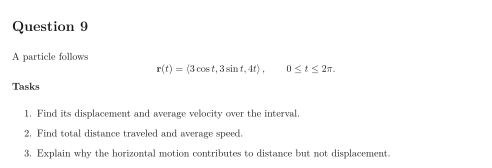
Question 9

A particle follows 𝒓(t)=⟨3cost,3sint,4t⟩,0≀t≀2Ο€.\mathbf r(t)=\left\langle 3\cos t,3\sin t,4t\right\rangle,\qquad 0\le t\le 2\pi. Tasks

  1. Find its displacement and average velocity over the interval.

  2. Find total distance traveled and average speed.

  3. Explain why the horizontal motion contributes to distance but not displacement.
Original worksheet page 1: question and worked solution for 1-11-009
Show solutionHide solution

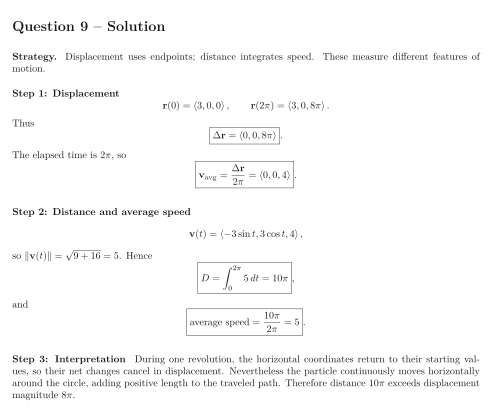
Question 9 – Solution

Strategy. Displacement uses endpoints; distance integrates speed. These measure different features of motion.

Step 1: Displacement 𝒓(0)=⟨3,0,0⟩,𝒓(2Ο€)=⟨3,0,8Ο€βŸ©.\mathbf r(0)=\left\langle 3,0,0\right\rangle,\qquad \mathbf r(2\pi)=\left\langle 3,0,8\pi\right\rangle. Thus Δ𝒓=⟨0,0,8Ο€βŸ©.\boxed{\Delta\mathbf r=\left\langle 0,0,8\pi\right\rangle}. The elapsed time is 2Ο€2\pi, so 𝒗avg=Δ𝒓2Ο€=⟨0,0,4⟩.\boxed{\mathbf v_{\mathrm{avg}}=\frac{\Delta\mathbf r}{2\pi}=\left\langle 0,0,4\right\rangle}.

Step 2: Distance and average speed 𝒗(t)=βŸ¨βˆ’3sint,3cost,4⟩,\mathbf v(t)=\left\langle -3\sin t,3\cos t,4\right\rangle, so βˆ₯𝒗(t)βˆ₯=9+16=5\|\mathbf v(t)\|=\sqrt{9+16}=5. Hence D=∫02Ο€5dt=10Ο€,\boxed{D=\int_0^{2\pi}5\,dt=10\pi}, and average speed=10Ο€2Ο€=5.\boxed{\text{average speed}=\frac{10\pi}{2\pi}=5}.

Step 3: Interpretation During one revolution, the horizontal coordinates return to their starting values, so their net changes cancel in displacement. Nevertheless the particle continuously moves horizontally around the circle, adding positive length to the traveled path. Therefore distance 10Ο€10\pi exceeds displacement magnitude 8Ο€8\pi.

Original worksheet page 2: question and worked solution for 1-11-009

Original worksheet layout. Use Enlarge or open the PDF for a closer view.