Equations of Planes — Question 1

PDF ↗

Question 1

A plane passes through A=(1,0,2),B=(3,1,−1),C=(−1,4,0).A=(1,0,2),\qquad B=(3,1,-1),\qquad C=(-1,4,0). Tasks

  1. Derive a Cartesian equation of the plane from two in-plane vectors.

  2. Write a unit normal vector.

  3. Find all three coordinate-axis intercepts and verify the three given points.
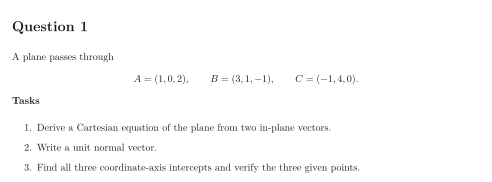
Original worksheet page 1: question and worked solution for 1-3-001
Show solutionHide solution

Question 1 – Solution

Strategy Form AB→\overrightarrow{AB} and AC→\overrightarrow{AC}; their cross product is normal to the plane.

See the diagram in the original worksheet below.

Step 1: In-plane vectors Subtract coordinates component by component: AB→=B−A=⟨3−1,1−0,−1−2⟩=⟨2,1,−3⟩,\overrightarrow{AB}=B-A=\left\langle 3-1,1-0,-1-2\right\rangle=\left\langle 2,1,-3\right\rangle, AC→=C−A=⟨−1−1,4−0,0−2⟩=⟨−2,4,−2⟩.\overrightarrow{AC}=C-A=\left\langle -1-1,4-0,0-2\right\rangle=\left\langle -2,4,-2\right\rangle.

Step 2: Normal vector Their cross product is AB→×AC→=⟨1(−2)−(−3)(4),(−3)(−2)−2(−2),2(4)−1(−2)⟩=⟨10,10,10⟩.\overrightarrow{AB}\times\overrightarrow{AC} =\left\langle 1(-2)-(-3)(4),\ (-3)(-2)-2(-2),\ 2(4)-1(-2)\right\rangle =\left\langle 10,10,10\right\rangle. Divide by 1010 to use the primitive normal n→=⟨1,1,1⟩\vec n=\left\langle 1,1,1\right\rangle. The point-normal equation through AA is (x−1)+(y−0)+(z−2)=0.(x-1)+(y-0)+(z-2)=0. Therefore x+y+z=3,n̂=13⟨1,1,1⟩.\boxed{x+y+z=3},\qquad \boxed{\hat n=\frac 1{\sqrt 3}\left\langle 1,1,1\right\rangle}.

Step 3: Intercepts On the xx-axis, y=z=0y=z=0, so x=3x=3. The other axes work similarly: (3,0,0),(0,3,0),(0,0,3).\boxed{(3,0,0),\ (0,3,0),\ (0,0,3)}.

Verification Substitution of AA, BB, and CC gives 33 each time. The two in-plane vectors dot to zero with ⟨1,1,1⟩\left\langle 1,1,1\right\rangle, independently confirming the orientation.

Original worksheet page 2: question and worked solution for 1-3-001

Original worksheet layout. Use Enlarge or open the PDF for a closer view.