Calculus with Vector Functions β€” Question 2

PDF β†—

Question 2

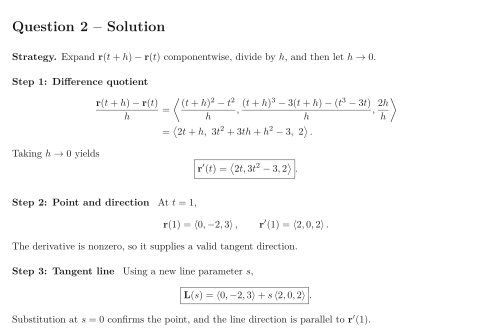
Let 𝒓(t)=⟨t2βˆ’1,t3βˆ’3t,2t+1⟩.\mathbf r(t)=\left\langle t^2-1,\ t^3-3t,\ 2t+1\right\rangle. Tasks

  1. Find 𝒓′(t)\mathbf r'(t) directly from the vector difference quotient.

  2. Find the tangent line at the point corresponding to t=1t=1.

  3. Verify that your direction vector is nonzero.
Original worksheet page 1: question and worked solution for 1-7-002
Show solutionHide solution

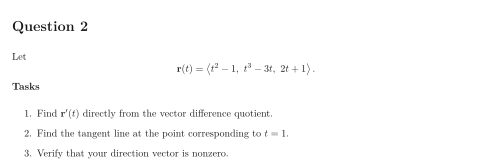
Question 2 – Solution

Strategy. Expand 𝒓(t+h)βˆ’π’“(t)\mathbf r(t+h)-\mathbf r(t) componentwise, divide by hh, and then let hβ†’0h\to 0.

Step 1: Difference quotient 𝒓(t+h)βˆ’π’“(t)h=⟨(t+h)2βˆ’t2h,(t+h)3βˆ’3(t+h)βˆ’(t3βˆ’3t)h,2hh⟩=⟨2t+h,3t2+3th+h2βˆ’3,2⟩.\begin{align*} \frac{\mathbf r(t+h)-\mathbf r(t)}h &=\left\langle \frac{(t+h)^2-t^2}{h}, \frac{(t+h)^3-3(t+h)-(t^3-3t)}h, \frac{2h}{h}\right\rangle\\ &=\left\langle 2t+h,\ 3t^2+3th+h^2-3,\ 2\right\rangle. \end{align*} Taking hβ†’0h\to 0 yields 𝒓′(t)=⟨2t,3t2βˆ’3,2⟩.\boxed{\mathbf r'(t)=\left\langle 2t,3t^2-3,2\right\rangle}.

Step 2: Point and direction At t=1t=1, 𝒓(1)=⟨0,βˆ’2,3⟩,𝒓′(1)=⟨2,0,2⟩.\mathbf r(1)=\left\langle 0,-2,3\right\rangle,\qquad \mathbf r'(1)=\left\langle 2,0,2\right\rangle. The derivative is nonzero, so it supplies a valid tangent direction.

Step 3: Tangent line Using a new line parameter ss, 𝑳(s)=⟨0,βˆ’2,3⟩+s⟨2,0,2⟩.\boxed{\mathbf L(s)=\left\langle 0,-2,3\right\rangle+s\left\langle 2,0,2\right\rangle}. Substitution at s=0s=0 confirms the point, and the line direction is parallel to 𝒓′(1)\mathbf r'(1).

Original worksheet page 2: question and worked solution for 1-7-002

Original worksheet layout. Use Enlarge or open the PDF for a closer view.