Tangent, Normal and Binormal Vectors β€” Question 3

PDF β†—

Question 3

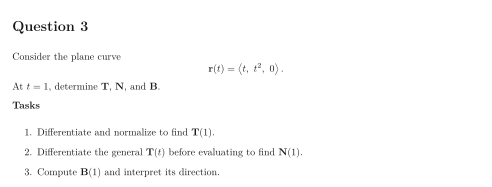
Consider the plane curve 𝒓(t)=⟨t,t2,0⟩.\mathbf r(t)=\left\langle t,\ t^2,\ 0\right\rangle. At t=1t=1, determine 𝑻\mathbf T, 𝑡\mathbf N, and 𝑩\mathbf B.

Tasks

  1. Differentiate and normalize to find 𝑻(1)\mathbf T(1).

  2. Differentiate the general 𝑻(t)\mathbf T(t) before evaluating to find 𝑡(1)\mathbf N(1).

  3. Compute 𝑩(1)\mathbf B(1) and interpret its direction.

Original worksheet page 1: question and worked solution for 1-8-003
Show solutionHide solution

Question 3 – Solution

Strategy. Computing 𝑻′(1)\mathbf T'(1) requires differentiating the normalized tangent, not merely normalizing 𝒓″(1)\mathbf r''(1).

Step 1: Unit tangent 𝒓′(t)=⟨1,2t,0⟩,𝑻(t)=⟨1,2t,0⟩1+4t2.\mathbf r'(t)=\left\langle 1,2t,0\right\rangle,\qquad \mathbf T(t)=\frac{\left\langle 1,2t,0\right\rangle}{\sqrt{1+4t^2}}. Hence 𝑻(1)=15⟨1,2,0⟩.\boxed{\mathbf T(1)=\frac 1{\sqrt 5}\left\langle 1,2,0\right\rangle}.

Step 2: Differentiate 𝑻\mathbf T Componentwise differentiation gives 𝑻′(t)=1(1+4t2)3/2βŸ¨βˆ’4t,2,0⟩.\mathbf T'(t)=\frac 1{(1+4t^2)^{3/2}}\left\langle -4t,2,0\right\rangle. At t=1t=1 this vector is a positive multiple of βŸ¨βˆ’2,1,0⟩\left\langle -2,1,0\right\rangle, whose length is 5\sqrt 5. Therefore 𝑡(1)=15βŸ¨βˆ’2,1,0⟩.\boxed{\mathbf N(1)=\frac 1{\sqrt 5}\left\langle -2,1,0\right\rangle}.

Step 3: Binormal 𝑩(1)=𝑻(1)×𝑡(1)=15⟨1,2,0βŸ©Γ—βŸ¨βˆ’2,1,0⟩=⟨0,0,1⟩.\mathbf B(1)=\mathbf T(1)\times\mathbf N(1) =\frac 15\left\langle 1,2,0\right\rangle\times\left\langle -2,1,0\right\rangle =\boxed{\left\langle 0,0,1\right\rangle}. The curve lies in the xyxy-plane, so its binormal points perpendicular to that plane. The three vectors are unit length and mutually perpendicular.
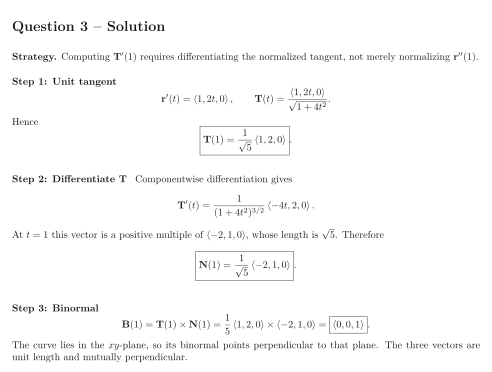
Original worksheet page 2: question and worked solution for 1-8-003

Original worksheet layout. Use Enlarge or open the PDF for a closer view.