Partial Derivatives — Question 9

PDF ↗

Question 9

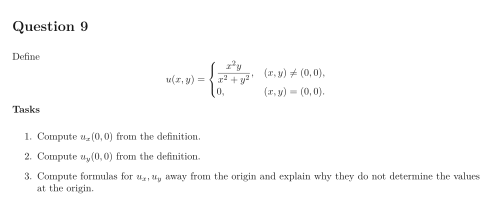
Define u(x,y)={x2yx2+y2,(x,y)≠(0,0),0,(x,y)=(0,0).u(x,y)= \begin{cases} \dfrac{x^2y}{x^2+y^2},&(x,y)\ne(0,0),\\ 0,&(x,y)=(0,0). \end{cases} Tasks

  1. Compute ux(0,0)u_x(0,0) from the definition.

  2. Compute uy(0,0)u_y(0,0) from the definition.

  3. Compute formulas for ux,uyu_x,u_y away from the origin and explain why they do not determine the values at the origin.
Original worksheet page 1: question and worked solution for 2-2-009
Show solutionHide solution

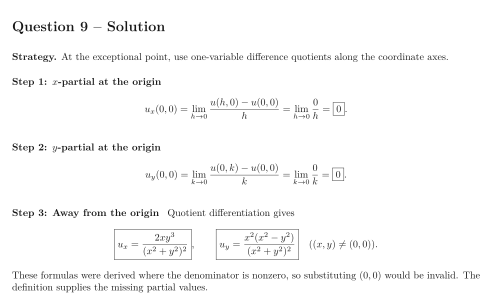
Question 9 – Solution

Strategy. At the exceptional point, use one-variable difference quotients along the coordinate axes.

Step 1: xx-partial at the origin ux(0,0)=limh→0u(h,0)−u(0,0)h=limh→00h=0.u_x(0,0)=\lim_{h\to 0}\frac{u(h,0)-u(0,0)}h=\lim_{h\to 0}\frac{0}{h}=\boxed 0.

Step 2: yy-partial at the origin uy(0,0)=limk→0u(0,k)−u(0,0)k=limk→00k=0.u_y(0,0)=\lim_{k\to 0}\frac{u(0,k)-u(0,0)}k=\lim_{k\to 0}\frac{0}{k}=\boxed 0.

Step 3: Away from the origin Quotient differentiation gives ux=2xy3(x2+y2)2,uy=x2(x2−y2)(x2+y2)2((x,y)≠(0,0)).\boxed{u_x=\frac{2xy^3}{(x^2+y^2)^2}},\qquad \boxed{u_y=\frac{x^2(x^2-y^2)}{(x^2+y^2)^2}}\quad ((x,y)\ne(0,0)). These formulas were derived where the denominator is nonzero, so substituting (0,0)(0,0) would be invalid. The definition supplies the missing partial values.
Original worksheet page 2: question and worked solution for 2-2-009

Original worksheet layout. Use Enlarge or open the PDF for a closer view.