Partial Derivatives — Question 10

PDF ↗

Question 10

Define v(x,y)={xyx2+y2,(x,y)≠(0,0),0,(x,y)=(0,0).v(x,y)= \begin{cases} \dfrac{xy}{x^2+y^2},&(x,y)\ne(0,0),\\ 0,&(x,y)=(0,0). \end{cases} Tasks

  1. Show that both first partial derivatives exist at the origin.

  2. Test continuity along y=xy=x.

  3. Explain what this example proves about partial derivatives and continuity.
Original worksheet page 1: question and worked solution for 2-2-010
Show solutionHide solution

Question 10 – Solution

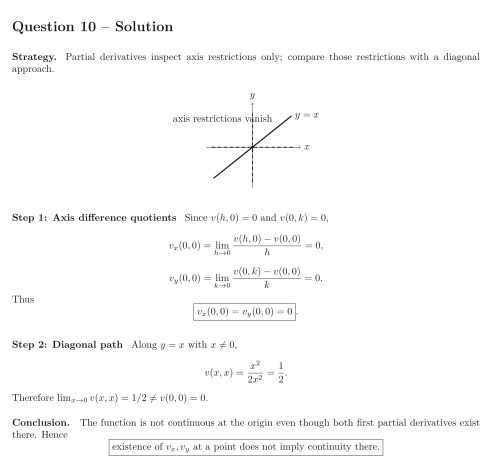
Strategy. Partial derivatives inspect axis restrictions only; compare those restrictions with a diagonal approach.

See the diagram in the original worksheet below.

Step 1: Axis difference quotients Since v(h,0)=0v(h,0)=0 and v(0,k)=0v(0,k)=0, vx(0,0)=limh→0v(h,0)−v(0,0)h=0,v_x(0,0)=\lim_{h\to 0}\frac{v(h,0)-v(0,0)}h=0, vy(0,0)=limk→0v(0,k)−v(0,0)k=0.v_y(0,0)=\lim_{k\to 0}\frac{v(0,k)-v(0,0)}k=0. Thus vx(0,0)=vy(0,0)=0.\boxed{v_x(0,0)=v_y(0,0)=0}.

Step 2: Diagonal path Along y=xy=x with x≠0x\ne 0, v(x,x)=x22x2=12.v(x,x)=\frac{x^2}{2x^2}=\frac 12. Therefore lim⁡x→0v(x,x)=1/2≠v(0,0)=0\lim_{x\to 0}v(x,x)=1/2\ne v(0,0)=0.

Conclusion. The function is not continuous at the origin even though both first partial derivatives exist there. Hence existence of vx,vy at a point does not imply continuity there.\boxed{\text{existence of }v_x,v_y\text{ at a point does not imply continuity there}.}
Original worksheet page 2: question and worked solution for 2-2-010

Original worksheet layout. Use Enlarge or open the PDF for a closer view.