Higher Order Partial Derivatives — Question 5

PDF ↗

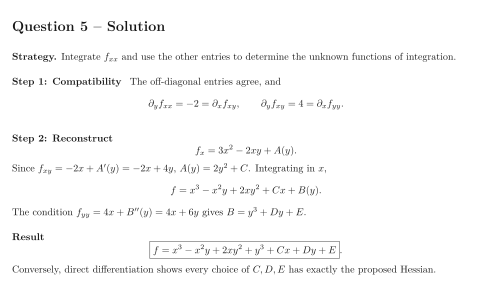
Question 5

A proposed Hessian is Hf(x,y)=(6x−2y−2x+4y−2x+4y4x+6y).H_f(x,y)=\begin{pmatrix}6x-2y&-2x+4y\\-2x+4y&4x+6y\end{pmatrix}. Tasks

  1. Check its compatibility conditions.

  2. Recover one possible f(x,y)f(x,y).

  3. Describe every function with this Hessian.
Original worksheet page 1: question and worked solution for 2-4-005
Show solutionHide solution

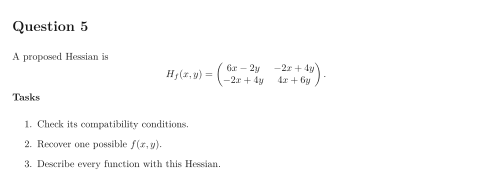
Question 5 – Solution

Strategy. Integrate fxxf_{xx} and use the other entries to determine the unknown functions of integration.

Step 1: Compatibility The off-diagonal entries agree, and ∂yfxx=−2=∂xfxy,∂yfxy=4=∂xfyy.\partial_y f_{xx}=-2=\partial_x f_{xy},\qquad \partial_y f_{xy}=4=\partial_x f_{yy}.

Step 2: Reconstruct fx=3x2−2xy+A(y).f_x=3x^2-2xy+A(y). Since fxy=−2x+A′(y)=−2x+4yf_{xy}=-2x+A'(y)=-2x+4y, A(y)=2y2+CA(y)=2y^2+C. Integrating in xx, f=x3−x2y+2xy2+Cx+B(y).f=x^3-x^2y+2xy^2+Cx+B(y). The condition fyy=4x+B″(y)=4x+6yf_{yy}=4x+B''(y)=4x+6y gives B=y3+Dy+EB=y^3+Dy+E.

Result f=x3−x2y+2xy2+y3+Cx+Dy+E.\boxed{f=x^3-x^2y+2xy^2+y^3+Cx+Dy+E}. Conversely, direct differentiation shows every choice of C,D,EC,D,E has exactly the proposed Hessian.

Original worksheet page 2: question and worked solution for 2-4-005

Original worksheet layout. Use Enlarge or open the PDF for a closer view.