Higher Order Partial Derivatives — Question 6

PDF ↗

Question 6

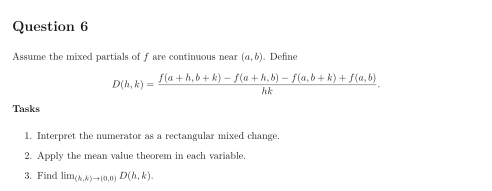
Assume the mixed partials of ff are continuous near (a,b)(a,b). Define D(h,k)=f(a+h,b+k)−f(a+h,b)−f(a,b+k)+f(a,b)hk.D(h,k)=\frac{f(a+h,b+k)-f(a+h,b)-f(a,b+k)+f(a,b)}{hk}. Tasks

  1. Interpret the numerator as a rectangular mixed change.

  2. Apply the mean value theorem in each variable.

  3. Find lim⁡(h,k)→(0,0)D(h,k)\lim_{(h,k)\to(0,0)}D(h,k).

Original worksheet page 1: question and worked solution for 2-4-006
Show solutionHide solution

Question 6 – Solution

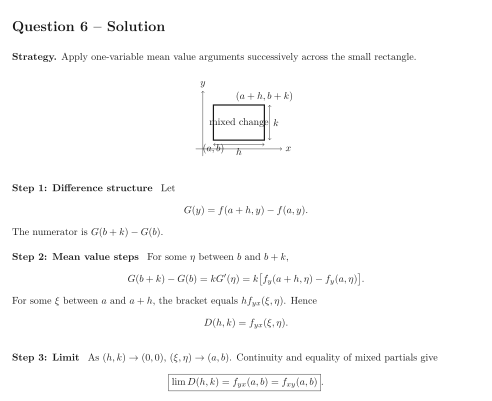
Strategy. Apply one-variable mean value arguments successively across the small rectangle.

See the diagram in the original worksheet below.

Step 1: Difference structure Let G(y)=f(a+h,y)−f(a,y).G(y)=f(a+h,y)-f(a,y). The numerator is G(b+k)−G(b)G(b+k)-G(b).

Step 2: Mean value steps For some η\eta between bb and b+kb+k, G(b+k)−G(b)=kG′(η)=k[fy(a+h,η)−fy(a,η)].G(b+k)-G(b)=kG'(\eta) =k\bigl[f_y(a+h,\eta)-f_y(a,\eta)\bigr]. For some ξ\xi between aa and a+ha+h, the bracket equals hfyx(ξ,η)h f_{yx}(\xi,\eta). Hence D(h,k)=fyx(ξ,η).D(h,k)=f_{yx}(\xi,\eta).

Step 3: Limit As (h,k)→(0,0)(h,k)\to(0,0), (ξ,η)→(a,b)(\xi,\eta)\to(a,b). Continuity and equality of mixed partials give lim⁡D(h,k)=fyx(a,b)=fxy(a,b).\boxed{\lim D(h,k)=f_{yx}(a,b)=f_{xy}(a,b)}.
Original worksheet page 2: question and worked solution for 2-4-006

Original worksheet layout. Use Enlarge or open the PDF for a closer view.