Higher Order Partial Derivatives — Question 9

PDF ↗

Question 9

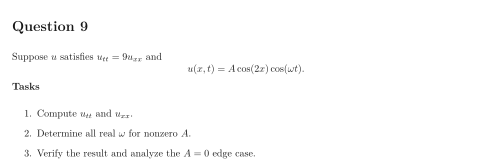
Suppose uu satisfies utt=9uxxu_{tt}=9u_{xx} and u(x,t)=Acos⁡(2x)cos⁡(ωt).u(x,t)=A\cos(2x)\cos(\omega t). Tasks

  1. Compute uttu_{tt} and uxxu_{xx}.

  2. Determine all real ω\omega for nonzero AA.

  3. Verify the result and analyze the A=0A=0 edge case.

Original worksheet page 1: question and worked solution for 2-4-009
Show solutionHide solution

Question 9 – Solution

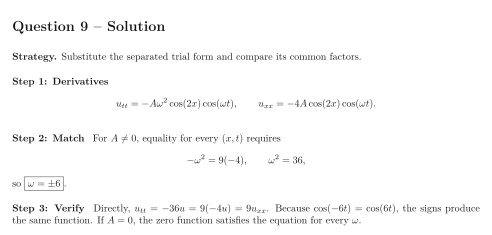
Strategy. Substitute the separated trial form and compare its common factors.

Step 1: Derivatives utt=−Aω2cos⁡(2x)cos⁡(ωt),uxx=−4Acos⁡(2x)cos⁡(ωt).u_{tt}=-A\omega^2\cos(2x)\cos(\omega t),\qquad u_{xx}=-4A\cos(2x)\cos(\omega t).

Step 2: Match For A≠0A\ne 0, equality for every (x,t)(x,t) requires −ω2=9(−4),ω2=36,-\omega^2=9(-4),\qquad\omega^2=36, so ω=±6\boxed{\omega=\pm 6}.

Step 3: Verify Directly, utt=−36u=9(−4u)=9uxxu_{tt}=-36u=9(-4u)=9u_{xx}. Because cos⁡(−6t)=cos⁡(6t)\cos(-6t)=\cos(6t), the signs produce the same function. If A=0A=0, the zero function satisfies the equation for every ω\omega.

Original worksheet page 2: question and worked solution for 2-4-009

Original worksheet layout. Use Enlarge or open the PDF for a closer view.