Higher Order Partial Derivatives — Question 10

PDF ↗

Question 10

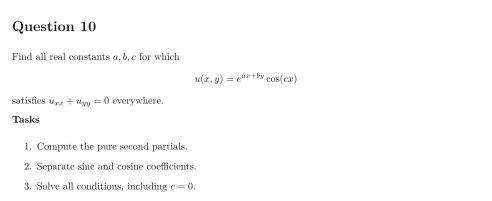
Find all real constants a,b,ca,b,c for which u(x,y)=eax+bycos⁡(cx)u(x,y)=e^{ax+by}\cos(cx) satisfies uxx+uyy=0u_{xx}+u_{yy}=0 everywhere.

Tasks

  1. Compute the pure second partials.

  2. Separate sine and cosine coefficients.

  3. Solve all conditions, including c=0c=0.

Original worksheet page 1: question and worked solution for 2-4-010
Show solutionHide solution

Question 10 – Solution

Strategy. Equality for every xx forces independent trigonometric coefficients to vanish.

Step 1: Differentiate uxx=eax+by[(a2−c2)cos⁡(cx)−2acsin⁡(cx)],u_{xx}=e^{ax+by}[(a^2-c^2)\cos(cx)-2ac\sin(cx)], uyy=b2eax+bycos⁡(cx).u_{yy}=b^2e^{ax+by}\cos(cx). Thus the sum is eax+by[(a2+b2−c2)cos⁡(cx)−2acsin⁡(cx)].e^{ax+by}[(a^2+b^2-c^2)\cos(cx)-2ac\sin(cx)].

Step 2: Nonzero cc If c≠0c\ne 0, independence of sine and cosine gives a2+b2−c2=0,ac=0.a^2+b^2-c^2=0,\qquad ac=0. Thus a=0a=0 and b=±cb=\pm c.

Step 3: Edge case If c=0c=0, the condition is a2+b2=0a^2+b^2=0, hence a=b=0a=b=0. This is already included below: (a,b,c)=(0,c,c)or(0,−c,c),c∈ℝ.\boxed{(a,b,c)=(0,c,c)\ \text{or}\ (0,-c,c),\quad c\in\mathbb R}. Substitution makes both coefficients vanish, verifying sufficiency.
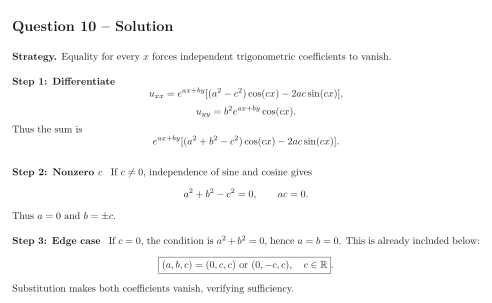
Original worksheet page 2: question and worked solution for 2-4-010

Original worksheet layout. Use Enlarge or open the PDF for a closer view.