Question 4
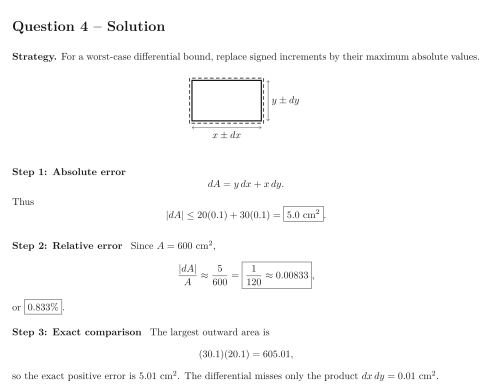
A rectangular plate has measured sides cm and cm, each accurate to within cm. Its area is .
Tasks
Use differentials to estimate the maximum absolute area error.
Estimate the maximum relative and percentage errors.
Compare with the exact worst-case outward error.
Show solutionHide solution
Question 4 – Solution
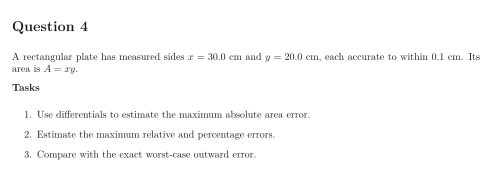
Strategy. For a worst-case differential bound, replace signed increments by their maximum absolute values.
See the diagram in the original worksheet below.
Step 1: Absolute error Thus
Step 2: Relative error Since cm, or .
Step 3: Exact comparison The largest outward area is so the exact positive error is cm. The differential misses only the product cm.