Differentials — Question 5

PDF ↗

Question 5

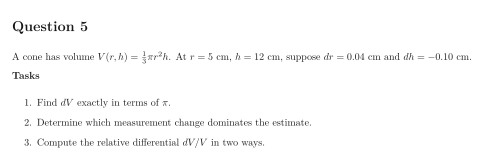
A cone has volume V(r,h)=13πr2hV(r,h)=\frac 13\pi r^2h. At r=5r=5 cm, h=12h=12 cm, suppose dr=0.04dr=0.04 cm and dh=−0.10dh=-0.10 cm.

Tasks

  1. Find dVdV exactly in terms of π\pi.

  2. Determine which measurement change dominates the estimate.

  3. Compute the relative differential dV/VdV/V in two ways.

Original worksheet page 1: question and worked solution for 2-5-005
Show solutionHide solution

Question 5 – Solution

Strategy. Compute component contributions, then confirm the relative formula by logarithmic structure.

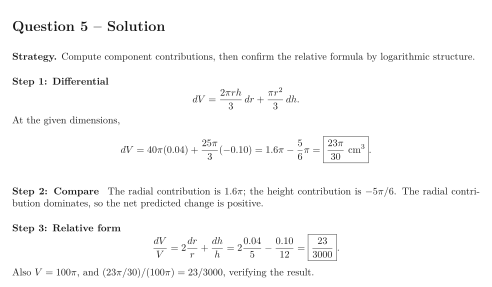
Step 1: Differential dV=2πrh3dr+πr23dh.dV=\frac{2\pi rh}{3}\,dr+\frac{\pi r^2}{3}\,dh. At the given dimensions, dV=40π(0.04)+25π3(−0.10)=1.6π−56π=23π30cm3.dV=40\pi(0.04)+\frac{25\pi}{3}(-0.10) =1.6\pi-\frac 56\pi=\boxed{\frac{23\pi}{30}\ \mathrm{cm^3}}.

Step 2: Compare The radial contribution is 1.6π1.6\pi; the height contribution is −5π/6-5\pi/6. The radial contribution dominates, so the net predicted change is positive.

Step 3: Relative form dVV=2drr+dhh=20.045−0.1012=233000.\frac{dV}{V}=2\frac{dr}{r}+\frac{dh}{h} =2\frac{0.04}{5}-\frac{0.10}{12} =\boxed{\frac{23}{3000}}. Also V=100πV=100\pi, and (23π/30)/(100π)=23/3000(23\pi/30)/(100\pi)=23/3000, verifying the result.

Original worksheet page 2: question and worked solution for 2-5-005

Original worksheet layout. Use Enlarge or open the PDF for a closer view.