Chain Rule — Question 7

PDF ↗

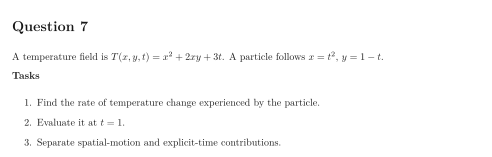
Question 7

A temperature field is T(x,y,t)=x2+2xy+3tT(x,y,t)=x^2+2xy+3t. A particle follows x=t2x=t^2, y=1−ty=1-t.

Tasks

  1. Find the rate of temperature change experienced by the particle.

  2. Evaluate it at t=1t=1.

  3. Separate spatial-motion and explicit-time contributions.
Original worksheet page 1: question and worked solution for 2-6-007
Show solutionHide solution

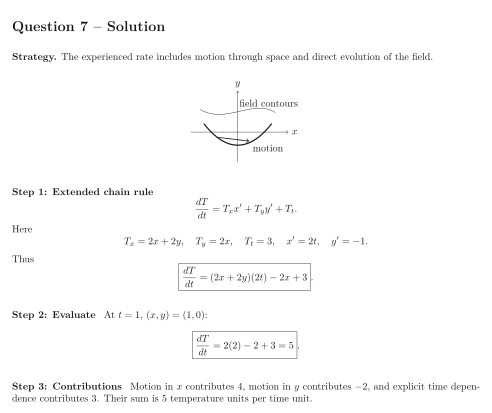
Question 7 – Solution

Strategy. The experienced rate includes motion through space and direct evolution of the field.

See the diagram in the original worksheet below.

Step 1: Extended chain rule dTdt=Txx′+Tyy′+Tt.\frac{dT}{dt}=T_xx'+T_yy'+T_t. Here Tx=2x+2y,Ty=2x,Tt=3,x′=2t,y′=−1.T_x=2x+2y,\quad T_y=2x,\quad T_t=3,\quad x'=2t,\quad y'=-1. Thus dTdt=(2x+2y)(2t)−2x+3.\boxed{\frac{dT}{dt}=(2x+2y)(2t)-2x+3}.

Step 2: Evaluate At t=1t=1, (x,y)=(1,0)(x,y)=(1,0): dTdt=2(2)−2+3=5.\boxed{\frac{dT}{dt}=2(2)-2+3=5}.

Step 3: Contributions Motion in xx contributes 44, motion in yy contributes −2-2, and explicit time dependence contributes 33. Their sum is 55 temperature units per time unit.

Original worksheet page 2: question and worked solution for 2-6-007

Original worksheet layout. Use Enlarge or open the PDF for a closer view.