Question 5
Let be continuously differentiable near . At , its level curve is smooth and . A unit direction makes angle with .
Tasks
Derive in terms of .
Explain why tangent motion along the level curve gives zero rate.
Determine the sign of the rate for acute, right, and obtuse .
Show solutionHide solution
Question 5 – Solution
Strategy. Combine the dot-product formula with the gradient’s normal relationship to level curves.
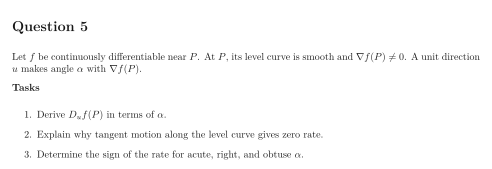
See the diagram in the original worksheet below.
Step 1: Angular formula
Step 2: Tangent direction Along the level curve, is constant, so its rate is zero. Geometrically the tangent is perpendicular to , giving and .
Step 3: Signs The rate is positive for acute , zero for a right angle, and negative for obtuse . Its magnitude is greatest when is parallel or antiparallel to the gradient.