Tangent Planes and Linear Approximations — Question 1

PDF ↗

Question 1

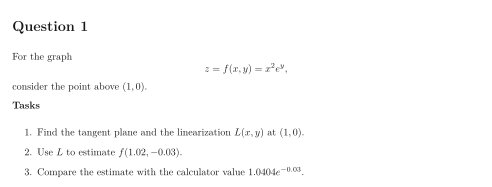
For the graph z=f(x,y)=x2ey,z=f(x,y)=x^2e^y, consider the point above (1,0)(1,0).

Tasks

  1. Find the tangent plane and the linearization L(x,y)L(x,y) at (1,0)(1,0).

  2. Use LL to estimate f(1.02,−0.03)f(1.02,-0.03).

  3. Compare the estimate with the calculator value 1.0404e−0.031.0404e^{-0.03}.

Original worksheet page 1: question and worked solution for 3-1-001
Show solutionHide solution

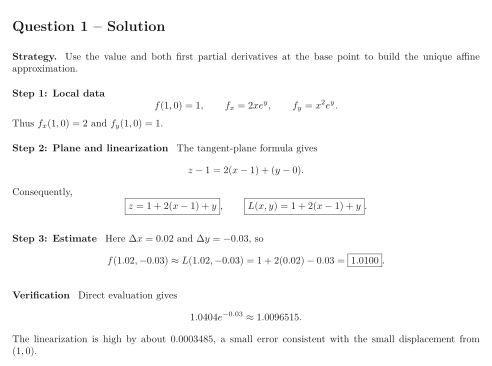
Question 1 – Solution

Strategy. Use the value and both first partial derivatives at the base point to build the unique affine approximation.

Step 1: Local data f(1,0)=1,fx=2xey,fy=x2ey.f(1,0)=1,\qquad f_x=2xe^y,\qquad f_y=x^2e^y. Thus fx(1,0)=2f_x(1,0)=2 and fy(1,0)=1f_y(1,0)=1.

Step 2: Plane and linearization The tangent-plane formula gives z−1=2(x−1)+(y−0).z-1=2(x-1)+(y-0). Consequently, z=1+2(x−1)+y,L(x,y)=1+2(x−1)+y.\boxed{z=1+2(x-1)+y},\qquad \boxed{L(x,y)=1+2(x-1)+y}.

Step 3: Estimate Here Δx=0.02\Delta x=0.02 and Δy=−0.03\Delta y=-0.03, so f(1.02,−0.03)≈L(1.02,−0.03)=1+2(0.02)−0.03=1.0100.f(1.02,-0.03)\approx L(1.02,-0.03) =1+2(0.02)-0.03=\boxed{1.0100}.

Verification Direct evaluation gives 1.0404e−0.03≈1.0096515.1.0404e^{-0.03}\approx 1.0096515. The linearization is high by about 0.00034850.0003485, a small error consistent with the small displacement from (1,0)(1,0).

Original worksheet page 2: question and worked solution for 3-1-001

Original worksheet layout. Use Enlarge or open the PDF for a closer view.