Question 4
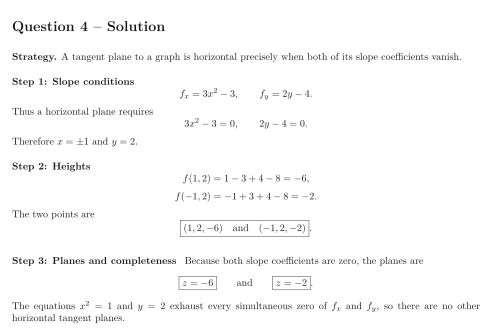
For the graph locate every point at which the tangent plane is horizontal.
Tasks
Translate “horizontal tangent plane” into conditions on the partial derivatives.
Find all corresponding points on the graph.
Write each horizontal tangent plane and show that no others exist.
Show solutionHide solution
Question 4 – Solution
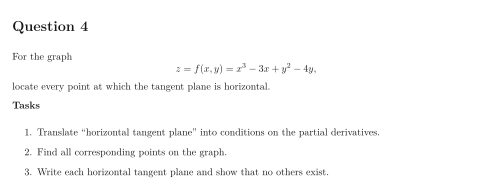
Strategy. A tangent plane to a graph is horizontal precisely when both of its slope coefficients vanish.
Step 1: Slope conditions Thus a horizontal plane requires Therefore and .
Step 2: Heights The two points are
Step 3: Planes and completeness Because both slope coefficients are zero, the planes are The equations and exhaust every simultaneous zero of and , so there are no other horizontal tangent planes.