Tangent Planes and Linear Approximations — Question 3

PDF ↗

Question 3

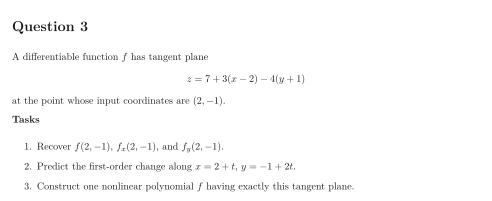
A differentiable function ff has tangent plane z=7+3(x−2)−4(y+1)z=7+3(x-2)-4(y+1) at the point whose input coordinates are (2,−1)(2,-1).

Tasks

  1. Recover f(2,−1)f(2,-1), fx(2,−1)f_x(2,-1), and fy(2,−1)f_y(2,-1).

  2. Predict the first-order change along x=2+tx=2+t, y=−1+2ty=-1+2t.

  3. Construct one nonlinear polynomial ff having exactly this tangent plane.

Original worksheet page 1: question and worked solution for 3-1-003
Show solutionHide solution

Question 3 – Solution

Strategy. Read the constant and slope coefficients from the standard linearization form, then add terms that vanish to first order.

Step 1: Recover the data Comparing with L=f(a,b)+fx(a,b)(x−a)+fy(a,b)(y−b)L=f(a,b)+f_x(a,b)(x-a)+f_y(a,b)(y-b) at (a,b)=(2,−1)(a,b)=(2,-1) gives f(2,−1)=7,fx(2,−1)=3,fy(2,−1)=−4.\boxed{f(2,-1)=7},\qquad \boxed{f_x(2,-1)=3},\qquad \boxed{f_y(2,-1)=-4}.

Step 2: Change along the path The input changes are Δx=t\Delta x=t and Δy=2t\Delta y=2t. Hence Δf≈3t−4(2t)=−5t.\Delta f\approx 3t-4(2t)=\boxed{-5t}.

Step 3: Construct an example One choice is f(x,y)=7+3(x−2)−4(y+1)+(x−2)2+(y+1)2.\boxed{f(x,y)=7+3(x-2)-4(y+1)+(x-2)^2+(y+1)^2}. The two quadratic terms and their first partial derivatives vanish at (2,−1)(2,-1), so they do not alter the tangent plane.

Verification Substitution gives f(2,−1)=7f(2,-1)=7. Differentiation gives fx=3+2(x−2)f_x=3+2(x-2) and fy=−4+2(y+1)f_y=-4+2(y+1), which reproduce the recovered slopes at the base point.
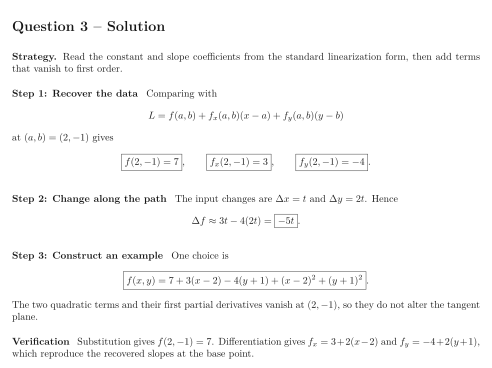
Original worksheet page 2: question and worked solution for 3-1-003

Original worksheet layout. Use Enlarge or open the PDF for a closer view.