Question 8
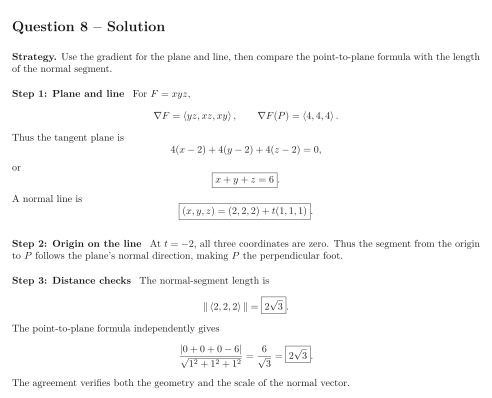
For the level surface let .
Tasks
Find the tangent plane and normal line at .
Show that the normal line passes through the origin.
Prove that is the perpendicular foot from the origin to the tangent plane and find that distance in two ways.
Show solutionHide solution
Question 8 – Solution
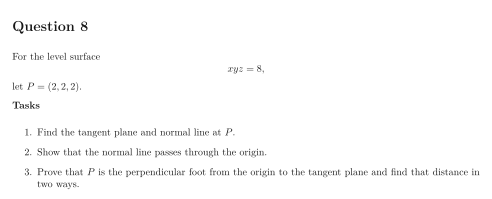
Strategy. Use the gradient for the plane and line, then compare the point-to-plane formula with the length of the normal segment.
Step 1: Plane and line For , Thus the tangent plane is or A normal line is
Step 2: Origin on the line At , all three coordinates are zero. Thus the segment from the origin to follows the plane’s normal direction, making the perpendicular foot.
Step 3: Distance checks The normal-segment length is The point-to-plane formula independently gives The agreement verifies both the geometry and the scale of the normal vector.