Question 1
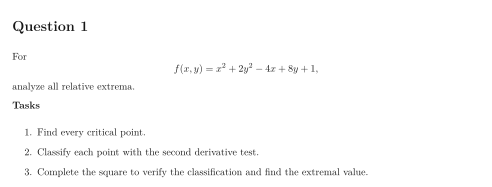
For analyze all relative extrema.
Tasks
Find every critical point.
Classify each point with the second derivative test.
Complete the square to verify the classification and find the extremal value.
Show solutionHide solution
Question 1 – Solution
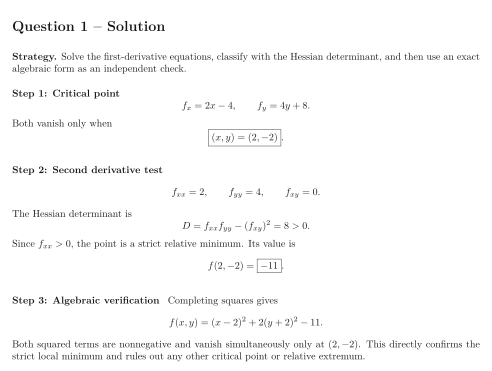
Strategy. Solve the first-derivative equations, classify with the Hessian determinant, and then use an exact algebraic form as an independent check.
Step 1: Critical point Both vanish only when
Step 2: Second derivative test The Hessian determinant is Since , the point is a strict relative minimum. Its value is
Step 3: Algebraic verification Completing squares gives Both squared terms are nonnegative and vanish simultaneously only at . This directly confirms the strict local minimum and rules out any other critical point or relative extremum.