Question 2
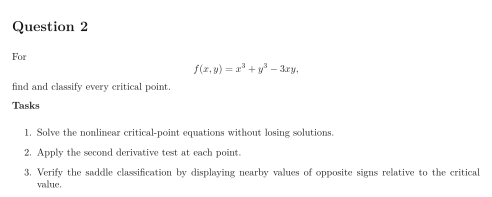
For find and classify every critical point.
Tasks
Solve the nonlinear critical-point equations without losing solutions.
Apply the second derivative test at each point.
Verify the saddle classification by displaying nearby values of opposite signs relative to the critical value.
Show solutionHide solution
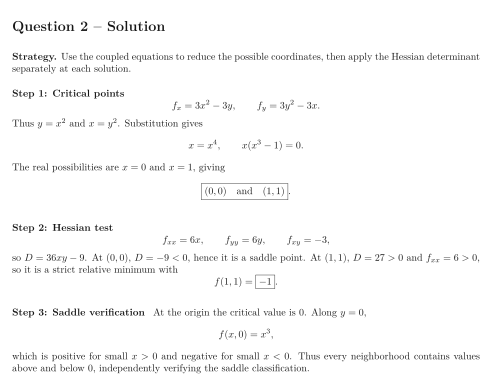
Question 2 – Solution
Strategy. Use the coupled equations to reduce the possible coordinates, then apply the Hessian determinant separately at each solution.
Step 1: Critical points Thus and . Substitution gives The real possibilities are and , giving
Step 2: Hessian test so . At , , hence it is a saddle point. At , and , so it is a strict relative minimum with
Step 3: Saddle verification At the origin the critical value is . Along , which is positive for small and negative for small . Thus every neighborhood contains values above and below , independently verifying the saddle classification.