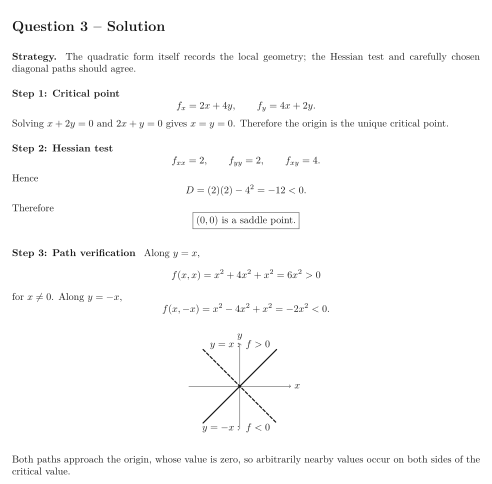
Question 3
Analyze the origin for
Tasks
Verify that the origin is the only critical point.
Classify it using the second derivative test.
Give two explicit paths that make the saddle geometry visible.
Show solutionHide solution
Question 3 – Solution
Strategy. The quadratic form itself records the local geometry; the Hessian test and carefully chosen diagonal paths should agree.
Step 1: Critical point Solving and gives . Therefore the origin is the unique critical point.
Step 2: Hessian test Hence Therefore
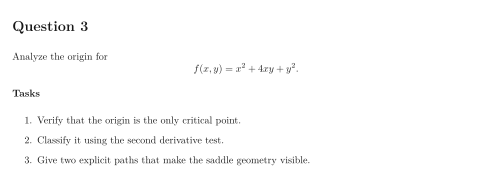
Step 3: Path verification Along , for . Along ,
See the diagram in the original worksheet below.
Both paths approach the origin, whose value is zero, so arbitrarily nearby values occur on both sides of the critical value.