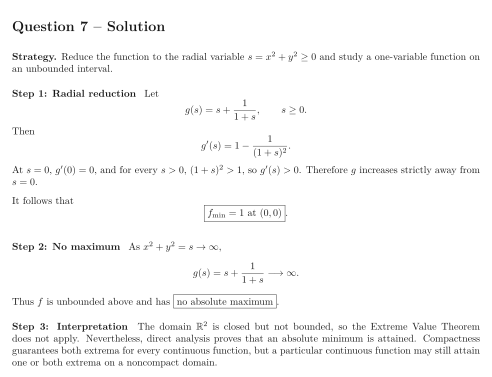
Question 7
On the unbounded domain , consider
Tasks
Determine all absolute minima and their value.
Decide whether an absolute maximum exists.
Explain why this example shows that compactness is sufficient, but not necessary, for an absolute minimum to exist.
Show solutionHide solution
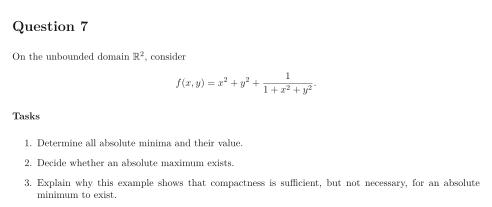
Question 7 – Solution
Strategy. Reduce the function to the radial variable and study a one-variable function on an unbounded interval.
Step 1: Radial reduction Let Then At , , and for every , , so . Therefore increases strictly away from .
It follows that
Step 2: No maximum As , Thus is unbounded above and has .
Step 3: Interpretation The domain is closed but not bounded, so the Extreme Value Theorem does not apply. Nevertheless, direct analysis proves that an absolute minimum is attained. Compactness guarantees both extrema for every continuous function, but a particular continuous function may still attain one or both extrema on a noncompact domain.