Question 1
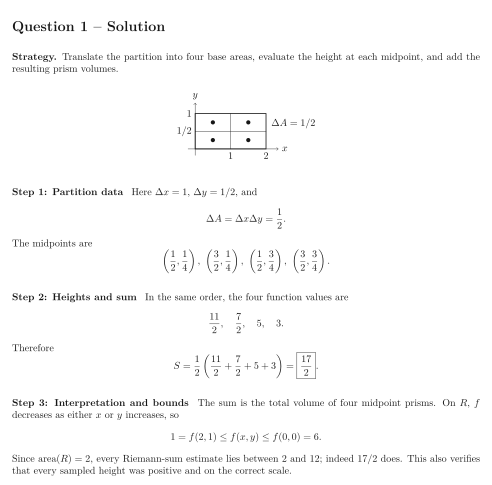
Let Partition into two equal columns and two equal rows, and use the midpoint of each subrectangle as its sample point.
Tasks
List the four sample points and the common subrectangle area.
Compute the midpoint Riemann sum.
Interpret the sum geometrically and check it against bounds from the minimum and maximum of on .
Show solutionHide solution
Question 1 – Solution
Strategy. Translate the partition into four base areas, evaluate the height at each midpoint, and add the resulting prism volumes.
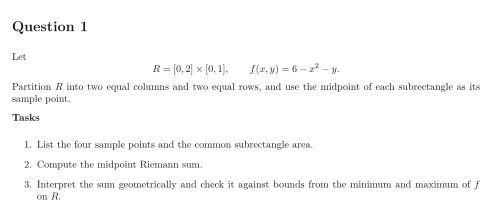
See the diagram in the original worksheet below.
Step 1: Partition data Here , , and The midpoints are
Step 2: Heights and sum In the same order, the four function values are Therefore
Step 3: Interpretation and bounds The sum is the total volume of four midpoint prisms. On , decreases as either or increases, so Since , every Riemann-sum estimate lies between and ; indeed does. This also verifies that every sampled height was positive and on the correct scale.