Question 6
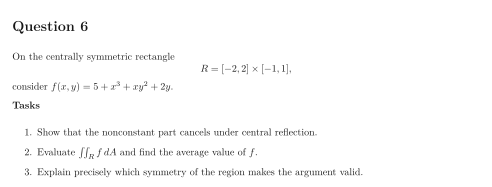
On the centrally symmetric rectangle consider .
Tasks
Show that the nonconstant part cancels under central reflection.
Evaluate and find the average value of .
Explain precisely which symmetry of the region makes the argument valid.
Show solutionHide solution
Question 6 – Solution
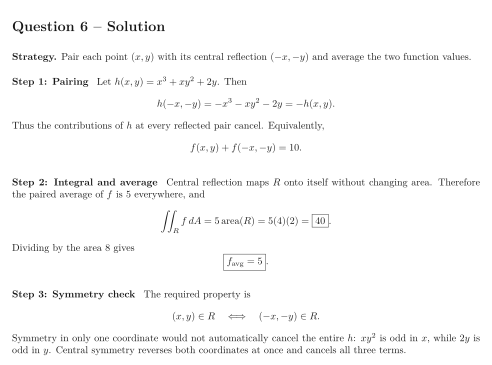
Strategy. Pair each point with its central reflection and average the two function values.
Step 1: Pairing Let . Then Thus the contributions of at every reflected pair cancel. Equivalently,
Step 2: Integral and average Central reflection maps onto itself without changing area. Therefore the paired average of is everywhere, and Dividing by the area gives
Step 3: Symmetry check The required property is Symmetry in only one coordinate would not automatically cancel the entire : is odd in , while is odd in . Central symmetry reverses both coordinates at once and cancels all three terms.