Line Integrals - Part II — Question 3

PDF ↗

Question 3

Let CC be the straight segment from A=(0,0)A=(0,0) to B=(2,1)B=(2,1). Evaluate ∫C(x+y)dx+(x−y)dy.\int_C (x+y)\,dx+(x-y)\,dy.

Tasks

  1. Parametrize the segment with the stated orientation.

  2. Convert both differentials to the parameter.

  3. Evaluate and check the endpoint orientation.
Original worksheet page 1: question and worked solution for 5-3-003
Show solutionHide solution

Question 3 – Solution

Strategy. A combined differential-form integral becomes one ordinary integral after substituting dx=x′(t)dtdx=x'(t)dt and dy=y′(t)dtdy=y'(t)dt.

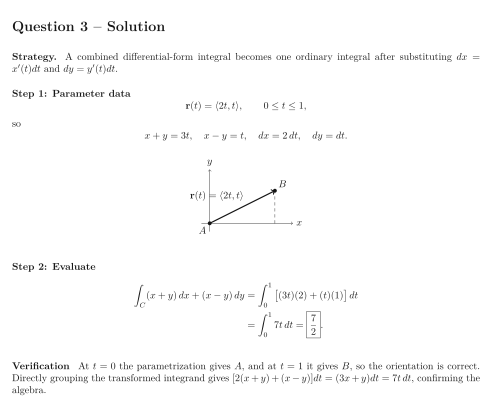
Step 1: Parameter data 𝒓(t)=⟨2t,t⟩,0≤t≤1,\mathbf r(t)=\langle 2t,t\rangle,\qquad 0\le t\le 1, so x+y=3t,x−y=t,dx=2dt,dy=dt.x+y=3t,\quad x-y=t,\quad dx=2\,dt,\quad dy=dt.

See the diagram in the original worksheet below.

Step 2: Evaluate ∫C(x+y)dx+(x−y)dy=∫01[(3t)(2)+(t)(1)]dt=∫017tdt=72.\begin{align*} \int_C (x+y)\,dx+(x-y)\,dy &=\int_0^1\big[(3t)(2)+(t)(1)\big]\,dt\\ &=\int_0^1 7t\,dt =\boxed{\frac 72}. \end{align*}

Verification At t=0t=0 the parametrization gives AA, and at t=1t=1 it gives BB, so the orientation is correct. Directly grouping the transformed integrand gives [2(x+y)+(x−y)]dt=(3x+y)dt=7tdt[2(x+y)+(x-y)]dt=(3x+y)dt=7t\,dt, confirming the algebra.

Original worksheet page 2: question and worked solution for 5-3-003

Original worksheet layout. Use Enlarge or open the PDF for a closer view.