Question 4
Let be the upper unit semicircle oriented from to , and let be the same arc with the reverse orientation. Compute for both orientations.
Tasks
Parametrize and evaluate the integral.
Obtain the value on .
Explain why orientation matters for but not for .
Show solutionHide solution
Question 4 – Solution
Strategy. Compute once in the counterclockwise direction, then use the sign change caused by reversing .
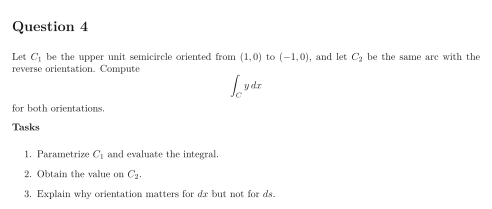
Step 1: Forward orientation For , use
See the diagram in the original worksheet below.
Therefore
Step 2: Reverse orientation Reversing the same curve negates the coordinate differential, so
Step 3: Why the rules differ Under reversal, changes sign because the derivative reverses. By contrast, uses a magnitude and remains nonnegative.
Verification On , while decreases, so and the integral must be nonpositive. Its reverse must be nonnegative, matching the two answers.