Line Integrals of Vector Fields β€” Question 3

PDF β†—

Question 3

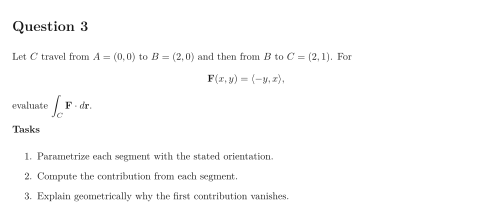
Let CC travel from A=(0,0)A=(0,0) to B=(2,0)B=(2,0) and then from BB to C=(2,1)C=(2,1). For 𝑭(x,y)=βŸ¨βˆ’y,x⟩,\mathbf F(x,y)=\langle-y,x\rangle, evaluate ∫C𝑭⋅d𝒓\displaystyle\int_C\mathbf F\cdot d\mathbf r.

Tasks

  1. Parametrize each segment with the stated orientation.

  2. Compute the contribution from each segment.

  3. Explain geometrically why the first contribution vanishes.
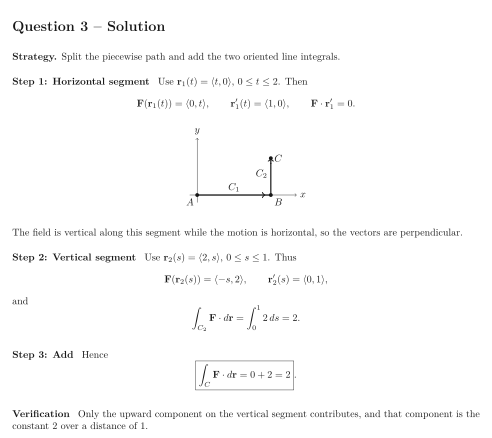
Original worksheet page 1: question and worked solution for 5-4-003
Show solutionHide solution

Question 3 – Solution

Strategy. Split the piecewise path and add the two oriented line integrals.

Step 1: Horizontal segment Use 𝒓1(t)=⟨t,0⟩\mathbf r_1(t)=\langle t,0\rangle, 0≀t≀20\le t\le 2. Then 𝑭(𝒓1(t))=⟨0,t⟩,𝒓1β€²(t)=⟨1,0⟩,𝑭⋅𝒓1β€²=0.\mathbf F(\mathbf r_1(t))=\langle 0,t\rangle,\qquad \mathbf r_1'(t)=\langle 1,0\rangle,\qquad \mathbf F\cdot\mathbf r_1'=0.

See the diagram in the original worksheet below.

The field is vertical along this segment while the motion is horizontal, so the vectors are perpendicular.

Step 2: Vertical segment Use 𝒓2(s)=⟨2,s⟩\mathbf r_2(s)=\langle 2,s\rangle, 0≀s≀10\le s\le 1. Thus 𝑭(𝒓2(s))=βŸ¨βˆ’s,2⟩,𝒓2β€²(s)=⟨0,1⟩,\mathbf F(\mathbf r_2(s))=\langle-s,2\rangle,\qquad \mathbf r_2'(s)=\langle 0,1\rangle, and ∫C2𝑭⋅d𝒓=∫012ds=2.\int_{C_2}\mathbf F\cdot d\mathbf r=\int_0^1 2\,ds=2.

Step 3: Add Hence ∫C𝑭⋅d𝒓=0+2=2.\boxed{\int_C\mathbf F\cdot d\mathbf r=0+2=2}.

Verification Only the upward component on the vertical segment contributes, and that component is the constant 22 over a distance of 11.

Original worksheet page 2: question and worked solution for 5-4-003

Original worksheet layout. Use Enlarge or open the PDF for a closer view.