Line Integrals of Vector Fields β€” Question 9

PDF β†—

Question 9

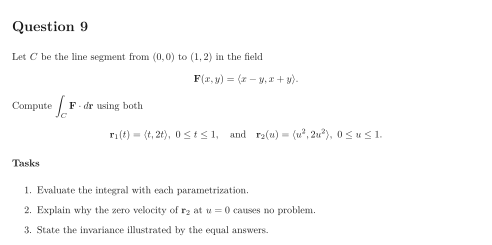
Let CC be the line segment from (0,0)(0,0) to (1,2)(1,2) in the field 𝑭(x,y)=⟨xβˆ’y,x+y⟩.\mathbf F(x,y)=\langle x-y,x+y\rangle. Compute ∫C𝑭⋅d𝒓\displaystyle\int_C\mathbf F\cdot d\mathbf r using both 𝒓1(t)=⟨t,2t⟩,0≀t≀1,and𝒓2(u)=⟨u2,2u2⟩,0≀u≀1.\mathbf r_1(t)=\langle t,2t\rangle,\ 0\le t\le 1, \quad\text{and}\quad \mathbf r_2(u)=\langle u^2,2u^2\rangle,\ 0\le u\le 1.

Tasks

  1. Evaluate the integral with each parametrization.

  2. Explain why the zero velocity of 𝒓2\mathbf r_2 at u=0u=0 causes no problem.

  3. State the invariance illustrated by the equal answers.
Original worksheet page 1: question and worked solution for 5-4-009
Show solutionHide solution

Question 9 – Solution

Strategy. Carry the parameter derivative through both computations; the slower start must be included in d𝒓d\mathbf r.

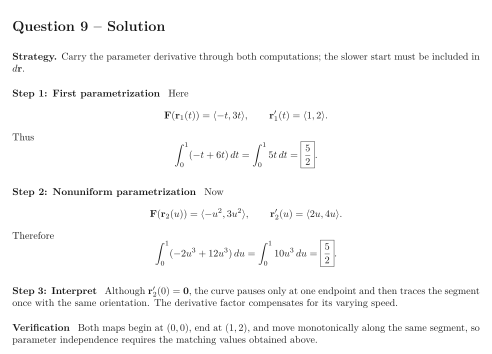
Step 1: First parametrization Here 𝑭(𝒓1(t))=βŸ¨βˆ’t,3t⟩,𝒓1β€²(t)=⟨1,2⟩.\mathbf F(\mathbf r_1(t))=\langle-t,3t\rangle,\qquad \mathbf r_1'(t)=\langle 1,2\rangle. Thus ∫01(βˆ’t+6t)dt=∫015tdt=52.\int_0^1(-t+6t)\,dt=\int_0^1 5t\,dt=\boxed{\frac 52}.

Step 2: Nonuniform parametrization Now 𝑭(𝒓2(u))=βŸ¨βˆ’u2,3u2⟩,𝒓2β€²(u)=⟨2u,4u⟩.\mathbf F(\mathbf r_2(u))=\langle-u^2,3u^2\rangle,\qquad \mathbf r_2'(u)=\langle 2u,4u\rangle. Therefore ∫01(βˆ’2u3+12u3)du=∫0110u3du=52.\int_0^1(-2u^3+12u^3)\,du =\int_0^1 10u^3\,du=\boxed{\frac 52}.

Step 3: Interpret Although 𝒓2β€²(0)=𝟎\mathbf r_2'(0)=\mathbf 0, the curve pauses only at one endpoint and then traces the segment once with the same orientation. The derivative factor compensates for its varying speed.

Verification Both maps begin at (0,0)(0,0), end at (1,2)(1,2), and move monotonically along the same segment, so parameter independence requires the matching values obtained above.
Original worksheet page 2: question and worked solution for 5-4-009

Original worksheet layout. Use Enlarge or open the PDF for a closer view.