Fundamental Theorem for Line Integrals β€” Question 5

PDF β†—

Question 5

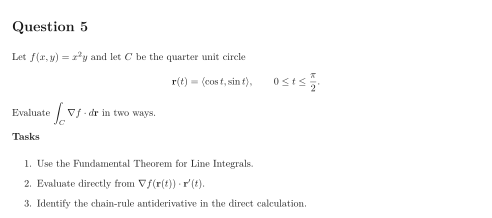
Let f(x,y)=x2yf(x,y)=x^2y and let CC be the quarter unit circle 𝒓(t)=⟨cos⁡t,sin⁡t⟩,0≀t≀π2.\mathbf r(t)=\langle\cos t,\sin t\rangle, \qquad 0\le t\le\frac{\pi}{2}. Evaluate ∫Cβˆ‡fβ‹…d𝒓\displaystyle\int_C\nabla f\cdot d\mathbf r in two ways.

Tasks

  1. Use the Fundamental Theorem for Line Integrals.

  2. Evaluate directly from βˆ‡f(𝒓(t))⋅𝒓′(t)\nabla f(\mathbf r(t))\cdot\mathbf r'(t).

  3. Identify the chain-rule antiderivative in the direct calculation.
Original worksheet page 1: question and worked solution for 5-5-005
Show solutionHide solution

Question 5 – Solution

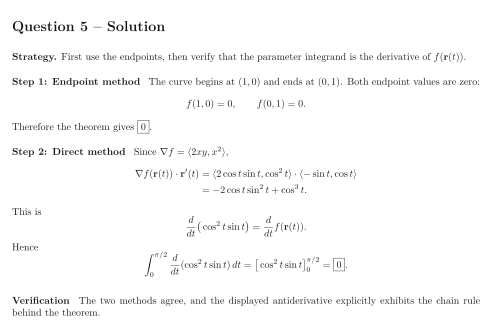
Strategy. First use the endpoints, then verify that the parameter integrand is the derivative of f(𝒓(t))f(\mathbf r(t)).

Step 1: Endpoint method The curve begins at (1,0)(1,0) and ends at (0,1)(0,1). Both endpoint values are zero: f(1,0)=0,f(0,1)=0.f(1,0)=0, \qquad f(0,1)=0. Therefore the theorem gives 0\boxed{0}.

Step 2: Direct method Since βˆ‡f=⟨2xy,x2⟩\nabla f=\langle 2xy,x^2\rangle, βˆ‡f(𝒓(t))⋅𝒓′(t)=⟨2cos⁡tsin⁡t,cos⁡2tβŸ©β‹…βŸ¨βˆ’sin⁡t,cos⁡t⟩=βˆ’2cos⁡tsin⁡2t+cos⁡3t.\begin{align*} \nabla f(\mathbf r(t))\cdot\mathbf r'(t) &=\langle 2\cos t\sin t,\cos^2t\rangle \cdot\langle-\sin t,\cos t\rangle\\ &=-2\cos t\sin^2t+\cos^3t. \end{align*} This is ddt(cos⁡2tsin⁡t)=ddtf(𝒓(t)).\frac{d}{dt}\big(\cos^2t\sin t\big) =\frac{d}{dt}f(\mathbf r(t)). Hence ∫0Ο€/2ddt(cos⁡2tsin⁡t)dt=[cos⁡2tsin⁡t]0Ο€/2=0.\int_0^{\pi/2}\frac{d}{dt}(\cos^2t\sin t)\,dt =\big[\cos^2t\sin t\big]_0^{\pi/2}=\boxed{0}.

Verification The two methods agree, and the displayed antiderivative explicitly exhibits the chain rule behind the theorem.
Original worksheet page 2: question and worked solution for 5-5-005

Original worksheet layout. Use Enlarge or open the PDF for a closer view.