Conservative Vector Fields β€” Question 5

PDF β†—

Question 5

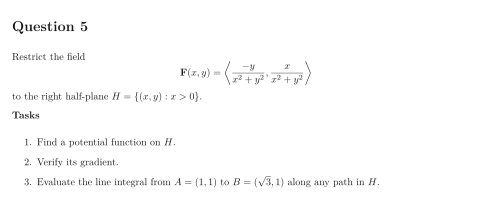
Restrict the field 𝑭(x,y)=βŸ¨βˆ’yx2+y2,xx2+y2⟩\mathbf F(x,y)=\left\langle\frac{-y}{x^2+y^2},\frac{x}{x^2+y^2}\right\rangle to the right half-plane H={(x,y):x>0}H=\{(x,y):x>0\}.

Tasks

  1. Find a potential function on HH.

  2. Verify its gradient.

  3. Evaluate the line integral from A=(1,1)A=(1,1) to B=(3,1)B=(\sqrt 3,1) along any path in HH.

Original worksheet page 1: question and worked solution for 5-6-005
Show solutionHide solution

Question 5 – Solution

Strategy. The right half-plane permits a single-valued angle function with no branch crossing.

Step 1: Choose the angle potential On x>0x>0, define f(x,y)=arctan⁡(yx).f(x,y)=\arctan\!\left(\frac yx\right). Using the chain rule, fx=βˆ’yx2+y2,fy=xx2+y2.f_x=\frac{-y}{x^2+y^2}, \qquad f_y=\frac{x}{x^2+y^2}. Hence βˆ‡f=𝑭\nabla f=\mathbf F on HH.

See the diagram in the original worksheet below.

Step 2: Evaluate by endpoints The endpoint angles in the branch (βˆ’Ο€/2,Ο€/2)(-\pi/2,\pi/2) are f(A)=arctan⁡(1)=Ο€4,f(B)=arctan⁡(13)=Ο€6.f(A)=\arctan(1)=\frac\pi 4, \qquad f(B)=\arctan\!\left(\frac 1{\sqrt 3}\right)=\frac\pi 6. Therefore ∫C𝑭⋅d𝒓=f(B)βˆ’f(A)=βˆ’Ο€12.\boxed{\int_C\mathbf F\cdot d\mathbf r=f(B)-f(A)=-\frac{\pi}{12}}.

Verification Both endpoints and the entire allowed path lie in x>0x>0, where the selected arctangent branch is continuous. The negative sign matches the decrease in polar angle from Ο€/4\pi/4 to Ο€/6\pi/6.

Original worksheet page 2: question and worked solution for 5-6-005

Original worksheet layout. Use Enlarge or open the PDF for a closer view.