Curl and Divergence β€” Question 6

PDF β†—

Question 6

For f(x,y,z)=x2y+yz2+xz,f(x,y,z)=x^2y+yz^2+xz, verify directly that βˆ‡Γ—(βˆ‡f)=𝟎.\nabla\times(\nabla f)=\mathbf 0.

Tasks

  1. Compute βˆ‡f\nabla f.

  2. Compute its curl and show each cancellation.

  3. State the smoothness principle behind the identity.
Original worksheet page 1: question and worked solution for 6-1-006
Show solutionHide solution

Question 6 – Solution

Strategy. Differentiate once to obtain the gradient and again in the curl’s cross-partial pairs.

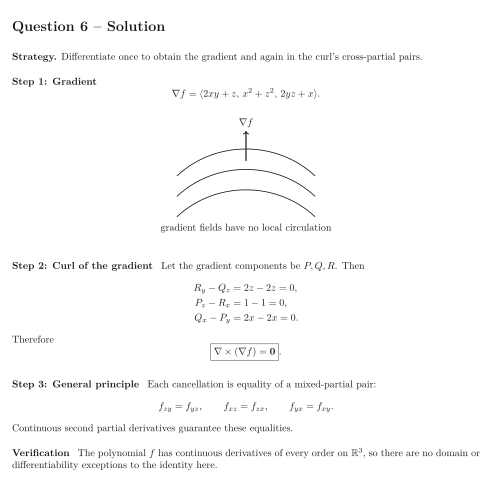
Step 1: Gradient βˆ‡f=⟨2xy+z,x2+z2,2yz+x⟩.\nabla f =\langle 2xy+z,\,x^2+z^2,\,2yz+x\rangle.

See the diagram in the original worksheet below.

Step 2: Curl of the gradient Let the gradient components be P,Q,RP,Q,R. Then Ryβˆ’Qz=2zβˆ’2z=0,Pzβˆ’Rx=1βˆ’1=0,Qxβˆ’Py=2xβˆ’2x=0.\begin{align*} R_y-Q_z&=2z-2z=0,\\ P_z-R_x&=1-1=0,\\ Q_x-P_y&=2x-2x=0. \end{align*} Therefore βˆ‡Γ—(βˆ‡f)=𝟎.\boxed{\nabla\times(\nabla f)=\mathbf 0}.

Step 3: General principle Each cancellation is equality of a mixed-partial pair: fzy=fyz,fxz=fzx,fyx=fxy.f_{zy}=f_{yz},\qquad f_{xz}=f_{zx},\qquad f_{yx}=f_{xy}. Continuous second partial derivatives guarantee these equalities.

Verification The polynomial ff has continuous derivatives of every order on ℝ3\mathbb R^3, so there are no domain or differentiability exceptions to the identity here.
Original worksheet page 2: question and worked solution for 6-1-006

Original worksheet layout. Use Enlarge or open the PDF for a closer view.