Surface Integrals of Vector Fields — Question 3

PDF ↗

Question 3

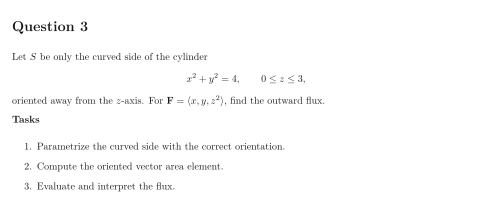
Let SS be only the curved side of the cylinder x2+y2=4,0≤z≤3,x^2+y^2=4,\qquad 0\le z\le 3, oriented away from the zz-axis. For 𝑭=⟨x,y,z2⟩\mathbf F=\langle x,y,z^2\rangle, find the outward flux.

Tasks

  1. Parametrize the curved side with the correct orientation.

  2. Compute the oriented vector area element.

  3. Evaluate and interpret the flux.

Original worksheet page 1: question and worked solution for 6-4-003
Show solutionHide solution

Question 3 – Solution

Strategy. Use angle and height parameters. The outward cross product is horizontal, so the vertical component of the field contributes nothing.

Step 1: Parametrize 𝒓(θ,z)=⟨2cos⁡θ,2sin⁡θ,z⟩,0≤θ≤2π,0≤z≤3.\mathbf r(\theta,z)=\langle 2\cos\theta,2\sin\theta,z\rangle, \quad 0\le\theta\le 2\pi,\quad 0\le z\le 3. The ordered cross product 𝒓θ×𝒓z=⟨2cos⁡θ,2sin⁡θ,0⟩\boxed{\mathbf r_\theta\times\mathbf r_z =\langle 2\cos\theta,2\sin\theta,0\rangle} points away from the axis.

See the diagram in the original worksheet below.

Step 2: Form the integrand On SS, 𝑭=⟨2cos⁡θ,2sin⁡θ,z2⟩,\mathbf F=\langle 2\cos\theta,2\sin\theta,z^2\rangle, and therefore 𝑭⋅(𝒓θ×𝒓z)=4cos⁡2θ+4sin⁡2θ=4.\mathbf F\cdot(\mathbf r_\theta\times\mathbf r_z) =4\cos^2\theta+4\sin^2\theta=4.

Step 3: Integrate ∬S𝑭⋅𝒏dS=∫02π∫034dzdθ=24π.\boxed{\iint_S\mathbf F\cdot\mathbf n\,dS =\int_0^{2\pi}\int_0^3 4\,dz\,d\theta=24\pi}.

Verification The flux density is constantly positive, so the field points outward through every point of the curved side. The z2z^2 component is tangent to that side and correctly disappears.

Original worksheet page 2: question and worked solution for 6-4-003

Original worksheet layout. Use Enlarge or open the PDF for a closer view.