Question 7
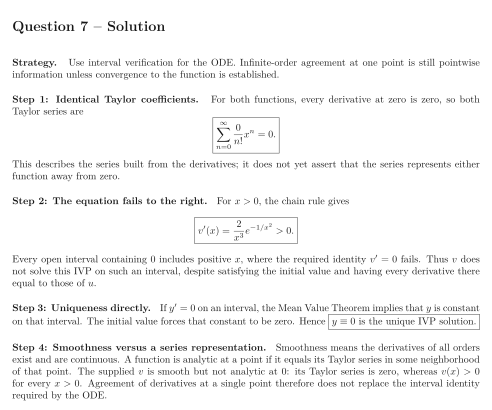
Consider the IVP , and the functions You may use the fact that is infinitely differentiable on and that for every integer .
Tasks
Determine the Taylor series at for both functions, using the given derivative information.
Calculate for and decide whether solves the IVP on any open interval containing .
Prove that is the only solution of the IVP on an interval containing .
Explain why agreement of every derivative at a single point does not contradict your conclusion. Distinguish a smooth function from one known to equal its Taylor series near that point.
Show solutionHide solution
Question 7 – Solution
Strategy. Use interval verification for the ODE. Infinite-order agreement at one point is still pointwise information unless convergence to the function is established.
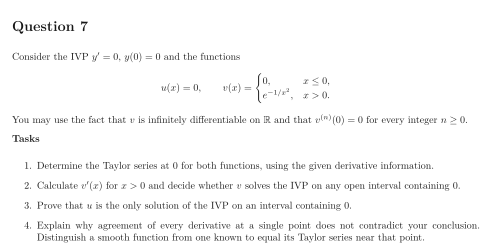
Step 1: Identical Taylor coefficients. For both functions, every derivative at zero is zero, so both Taylor series are This describes the series built from the derivatives; it does not yet assert that the series represents either function away from zero.
Step 2: The equation fails to the right. For , the chain rule gives Every open interval containing includes positive , where the required identity fails. Thus does not solve this IVP on such an interval, despite satisfying the initial value and having every derivative there equal to those of .
Step 3: Uniqueness directly. If on an interval, the Mean Value Theorem implies that is constant on that interval. The initial value forces that constant to be zero. Hence
Step 4: Smoothness versus a series representation. Smoothness means the derivatives of all orders exist and are continuous. A function is analytic at a point if it equals its Taylor series in some neighborhood of that point. The supplied is smooth but not analytic at : its Taylor series is zero, whereas for every . Agreement of derivatives at a single point therefore does not replace the interval identity required by the ODE.