Question 8
An implicit description of a function is proposed for : The associated initial value problem is You may use implicit differentiation where the coefficient of is nonzero.
Tasks
Show that for every fixed the implicit relation has exactly one positive root .
Differentiate the relation, verify the ODE and initial value, and calculate the initial slope. Explain why the denominator stays nonzero on this branch.
Prove that the branch decreases for and tends to zero as .
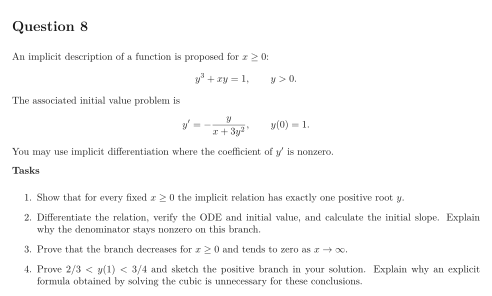
Prove and sketch the positive branch in your solution. Explain why an explicit formula obtained by solving the cubic is unnecessary for these conclusions.
Show solutionHide solution
Question 8 – Solution
Strategy. Establish a unique branch before differentiating. Monotonicity and inequalities can describe an implicit solution without an explicit cubic formula.
Step 1: A well-defined positive branch. For fixed , let . It is continuous, starts at , and tends to infinity as . For , , so the Intermediate Value Theorem and strict increase give exactly one positive root of .
Step 2: Verification. Differentiation yields The denominator is positive on the branch, allowing local differentiable continuation, including near . At zero the relation gives , so and .
See the diagram in the original worksheet below.
Step 3: Decrease and limit. Positivity of and the denominator implies . Also gives for , so the squeeze principle gives .
Step 4: A rigorous bracket. At , Strict increase in proves . Root existence, differentiation and inequalities establish these results directly; an explicit cubic formula adds no needed information.