Question 9
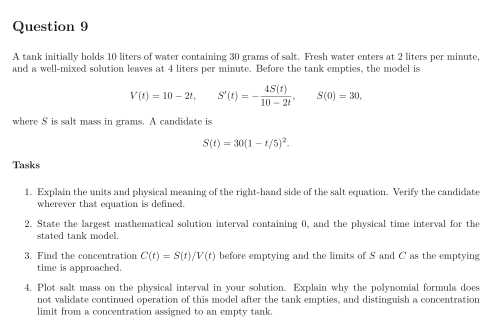
A tank initially holds liters of water containing grams of salt. Fresh water enters at liters per minute, and a well-mixed solution leaves at liters per minute. Before the tank empties, the model is where is salt mass in grams. A candidate is Tasks
Explain the units and physical meaning of the right-hand side of the salt equation. Verify the candidate wherever that equation is defined.
State the largest mathematical solution interval containing , and the physical time interval for the stated tank model.
Find the concentration before emptying and the limits of and as the emptying time is approached.
Plot salt mass on the physical interval in your solution. Explain why the polynomial formula does not validate continued operation of this model after the tank empties, and distinguish a concentration limit from a concentration assigned to an empty tank.
Show solutionHide solution
Question 9 – Solution
Strategy. Separate algebraic verification from the equation’s domain and from the physical assumptions behind it.
Step 1: Units and substitution. The concentration has units g/L; multiplying by the outflow L/min gives salt loss in g/min. Fresh inflow adds no salt. The candidate satisfies and .
Step 2: Two different intervals. The differential equation is undefined at . The largest open mathematical interval containing the initial time is . The stated experiment starts at and requires positive volume, so its physical interval is minutes.
See the diagram in the original worksheet below.
Step 3: Concentration and endpoint limits. Before emptying, At , both and have zero limits. The quotient is not defined for the empty tank, even though the pre-emptying concentration has a limit.
Step 4: Why a polynomial is not a license to extrapolate. The polynomial can be evaluated after , but would then be negative and the assumed outflow could not be maintained from this empty tank. The algebraic formula is not sufficient to preserve the model’s physical meaning or extend the original ODE across its undefined point.
