Question 10
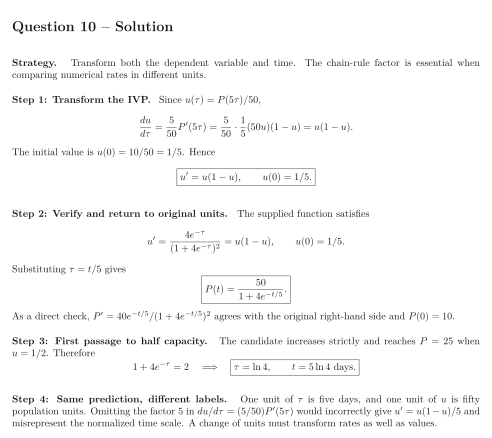
A population model in the original units is where is measured in days and has the same population units as . Define dimensionless variables A candidate for a normalized model is Tasks
Use the chain rule to derive the equation and initial value for .
Verify the candidate in the normalized variables, then express the corresponding in the original variables.
Find when the population first reaches , giving both dimensionless time and time in days.
Explain why changing units alters numerical slopes and time labels without producing a different physical prediction. Identify what would go wrong if the factor from were omitted in differentiation.
Show solutionHide solution
Question 10 – Solution
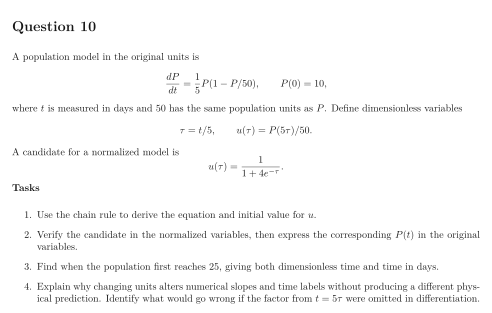
Strategy. Transform both the dependent variable and time. The chain-rule factor is essential when comparing numerical rates in different units.
Step 1: Transform the IVP. Since , The initial value is . Hence
Step 2: Verify and return to original units. The supplied function satisfies Substituting gives As a direct check, agrees with the original right-hand side and .
Step 3: First passage to half capacity. The candidate increases strictly and reaches when . Therefore
Step 4: Same prediction, different labels. One unit of is five days, and one unit of is fifty population units. Omitting the factor in would incorrectly give and misrepresent the normalized time scale. A change of units must transform rates as well as values.