Question 6
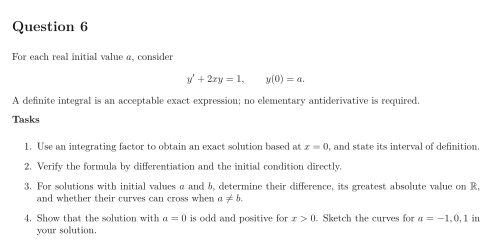
For each real initial value , consider A definite integral is an acceptable exact expression; no elementary antiderivative is required.
Tasks
Use an integrating factor to obtain an exact solution based at , and state its interval of definition.
Verify the formula by differentiation and the initial condition directly.
For solutions with initial values and , determine their difference, its greatest absolute value on , and whether their curves can cross when .
Show that the solution with is odd and positive for . Sketch the curves for in your solution.
Show solutionHide solution
Question 6 – Solution
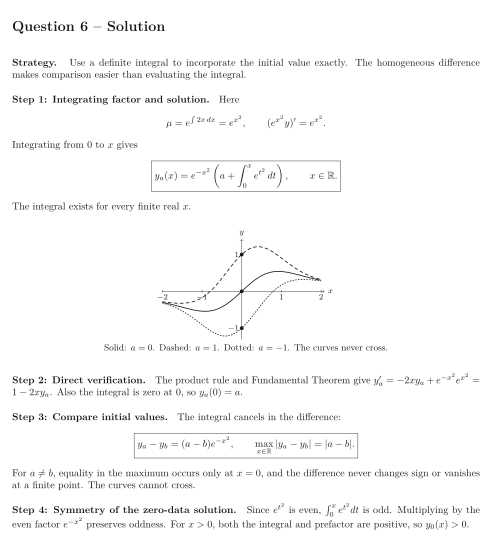
Strategy. Use a definite integral to incorporate the initial value exactly. The homogeneous difference makes comparison easier than evaluating the integral.
Step 1: Integrating factor and solution. Here Integrating from to gives The integral exists for every finite real .
See the diagram in the original worksheet below.
Step 2: Direct verification. The product rule and Fundamental Theorem give . Also the integral is zero at , so .
Step 3: Compare initial values. The integral cancels in the difference: For , equality in the maximum occurs only at , and the difference never changes sign or vanishes at a finite point. The curves cannot cross.
Step 4: Symmetry of the zero-data solution. Since is even, is odd. Multiplying by the even factor preserves oddness. For , both the integral and prefactor are positive, so .