Question 7
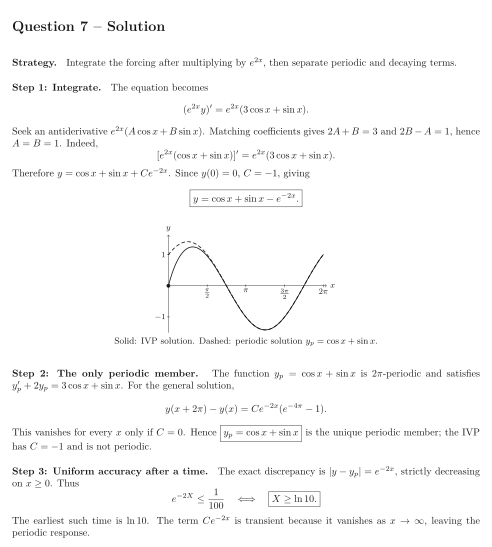
Consider the periodically forced equation with initial condition .
Tasks
Solve the IVP using an integrating factor. Show how you evaluate the integral of the forcing times that factor.
Find the unique -periodic solution of the equation, and verify both its periodicity and its differential equation.
Find the earliest such that the IVP solution differs from the periodic solution by at most for every .
Sketch the IVP solution and the periodic solution on in your solution. Explain which part of the general solution is the transient and why the prescribed IVP solution is not itself periodic.
Show solutionHide solution
Question 7 – Solution
Strategy. Integrate the forcing after multiplying by , then separate periodic and decaying terms.
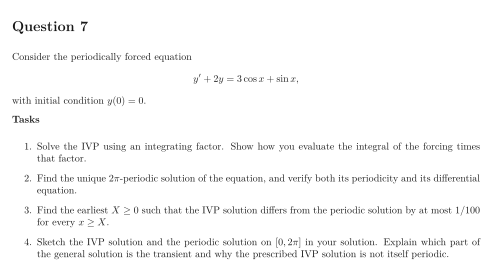
Step 1: Integrate. The equation becomes Seek an antiderivative . Matching coefficients gives and , hence . Indeed, Therefore . Since , , giving
See the diagram in the original worksheet below.
Step 2: The only periodic member. The function is -periodic and satisfies . For the general solution, This vanishes for every only if . Hence is the unique periodic member; the IVP has and is not periodic.
Step 3: Uniform accuracy after a time. The exact discrepancy is , strictly decreasing on . Thus The earliest such time is . The term is transient because it vanishes as , leaving the periodic response.