Question 8
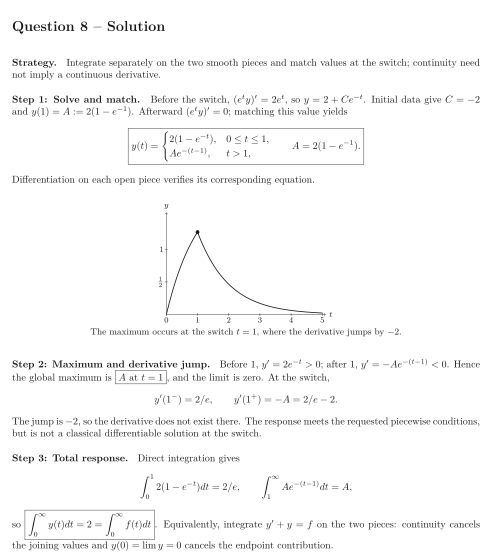
A switched forcing acts on a linear equation for : Seek a continuous function that is continuously differentiable on each side of and satisfies the equation away from that switching time. No derivative at is assumed.
Tasks
Solve on using an integrating factor, then use continuity to solve on .
Find the global maximum for , including its time, and the limit as .
Compute the left and right derivatives at . Is the resulting function a classical differentiable solution at that point?
Evaluate and relate it to the total forcing . Sketch the continuous response in your solution, showing the change in slope at the switch.
Show solutionHide solution
Question 8 – Solution
Strategy. Integrate separately on the two smooth pieces and match values at the switch; continuity need not imply a continuous derivative.
Step 1: Solve and match. Before the switch, , so . Initial data give and . Afterward ; matching this value yields Differentiation on each open piece verifies its corresponding equation.
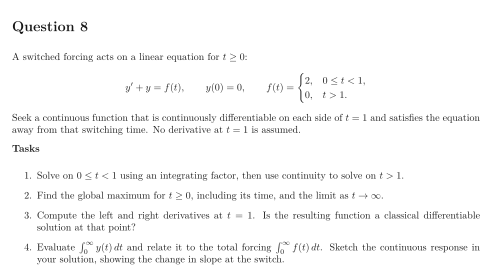
See the diagram in the original worksheet below.
Step 2: Maximum and derivative jump. Before , ; after , . Hence the global maximum is , and the limit is zero. At the switch, The jump is , so the derivative does not exist there. The response meets the requested piecewise conditions, but is not a classical differentiable solution at the switch.
Step 3: Total response. Direct integration gives so . Equivalently, integrate on the two pieces: continuity cancels the joining values and cancels the endpoint contribution.