Question 3
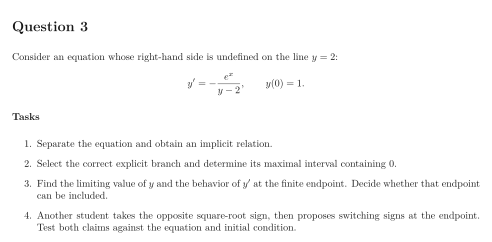
Consider an equation whose right-hand side is undefined on the line :
Tasks
Separate the equation and obtain an implicit relation.
Select the correct explicit branch and determine its maximal interval containing .
Find the limiting value of and the behavior of at the finite endpoint. Decide whether that endpoint can be included.
Another student takes the opposite square-root sign, then proposes switching signs at the endpoint. Test both claims against the equation and initial condition.
Show solutionHide solution
Question 3 – Solution
Strategy. Integration gives a squared relation; the initial condition and the excluded line determine which part is a solution.
Step 1: Integrate and choose the sign. At , , so . Since , continuity selects The radicand must be strictly positive: zero would give the forbidden value .
Step 2: Check behavior and verify. Throughout , As , . As , but . A finite limit of alone does not permit extension: the equation is undefined at the endpoint and a finite derivative is impossible there.
Step 3: Audit the other branch. The branch satisfies the differential equation on , but has , not . Switching signs would still pass through , and for larger the radicand is negative. Neither proposal extends the given real solution.
See the diagram in the original worksheet below.
