Question 4
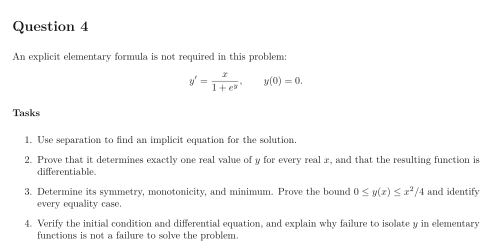
An explicit elementary formula is not required in this problem:
Tasks
Use separation to find an implicit equation for the solution.
Prove that it determines exactly one real value of for every real , and that the resulting function is differentiable.
Determine its symmetry, monotonicity, and minimum. Prove the bound and identify every equality case.
Verify the initial condition and differential equation, and explain why failure to isolate in elementary functions is not a failure to solve the problem.
Show solutionHide solution
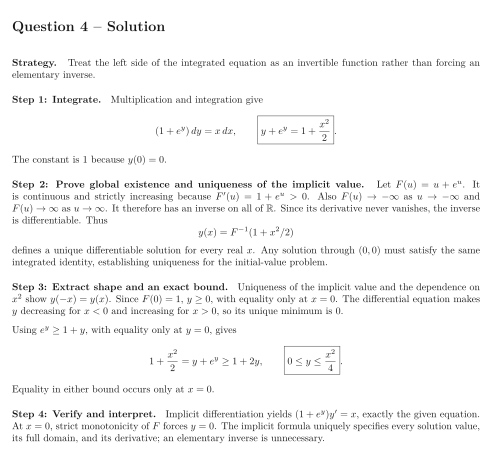
Question 4 – Solution
Strategy. Treat the left side of the integrated equation as an invertible function rather than forcing an elementary inverse.
Step 1: Integrate. Multiplication and integration give The constant is because .
Step 2: Prove global existence and uniqueness of the implicit value. Let . It is continuous and strictly increasing because . Also as and as . It therefore has an inverse on all of . Since its derivative never vanishes, the inverse is differentiable. Thus defines a unique differentiable solution for every real . Any solution through must satisfy the same integrated identity, establishing uniqueness for the initial-value problem.
Step 3: Extract shape and an exact bound. Uniqueness of the implicit value and the dependence on show . Since , , with equality only at . The differential equation makes decreasing for and increasing for , so its unique minimum is .
Using , with equality only at , gives Equality in either bound occurs only at .
Step 4: Verify and interpret. Implicit differentiation yields , exactly the given equation. At , strict monotonicity of forces . The implicit formula uniquely specifies every solution value, its full domain, and its derivative; an elementary inverse is unnecessary.