Question 1
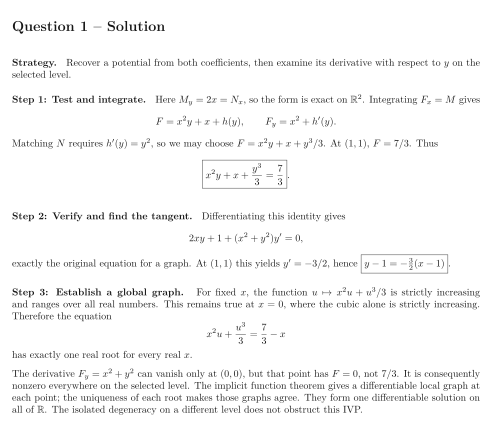
Consider the differential equation A potential for is a function satisfying and ; its level curves give implicit solutions.
Tasks
Check exactness and construct a potential, retaining the unknown function that arises when integrating with respect to .
Apply the initial condition and verify the resulting implicit solution by differentiation.
Find the slope and tangent line at .
Prove that the selected level determines a unique differentiable function on all of , despite the vanishing of at the origin.
Show solutionHide solution
Question 1 – Solution
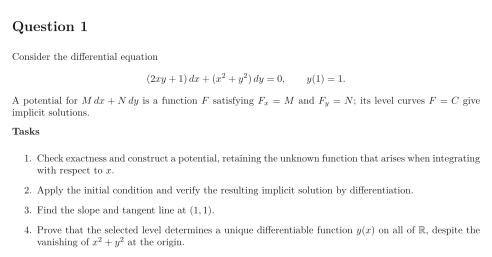
Strategy. Recover a potential from both coefficients, then examine its derivative with respect to on the selected level.
Step 1: Test and integrate. Here , so the form is exact on . Integrating gives Matching requires , so we may choose . At , . Thus
Step 2: Verify and find the tangent. Differentiating this identity gives exactly the original equation for a graph. At this yields , hence .
Step 3: Establish a global graph. For fixed , the function is strictly increasing and ranges over all real numbers. This remains true at , where the cubic alone is strictly increasing. Therefore the equation has exactly one real root for every real .
The derivative can vanish only at , but that point has , not . It is consequently nonzero everywhere on the selected level. The implicit function theorem gives a differentiable local graph at each point; the uniqueness of each root makes those graphs agree. They form one differentiable solution on all of . The isolated degeneracy on a different level does not obstruct this IVP.