Question 2
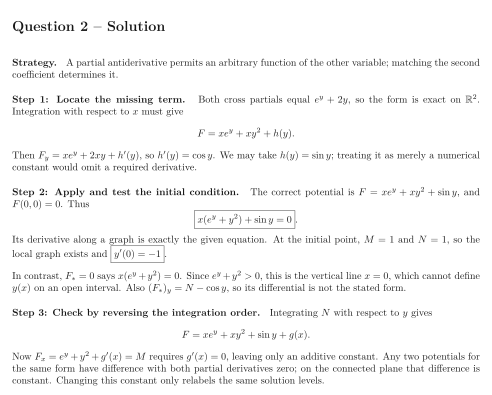
A student studies After integrating the coefficient of , the student writes and claims that solves the initial-value problem.
Tasks
Check exactness and identify precisely what is missing from the student’s integration.
Construct a correct potential and select the correct level using the data.
Compute the local slope at and explain why the student’s proposed level cannot be the required solution graph.
Integrate the coefficient of first as an independent check. Explain why the two correct potentials can differ by a constant.
Show solutionHide solution
Question 2 – Solution
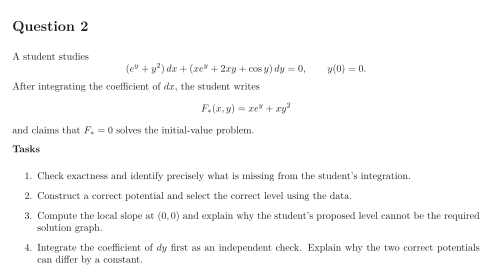
Strategy. A partial antiderivative permits an arbitrary function of the other variable; matching the second coefficient determines it.
Step 1: Locate the missing term. Both cross partials equal , so the form is exact on . Integration with respect to must give Then , so . We may take ; treating it as merely a numerical constant would omit a required derivative.
Step 2: Apply and test the initial condition. The correct potential is , and . Thus Its derivative along a graph is exactly the given equation. At the initial point, and , so the local graph exists and .
In contrast, says . Since , this is the vertical line , which cannot define on an open interval. Also , so its differential is not the stated form.
Step 3: Check by reversing the integration order. Integrating with respect to gives Now requires , leaving only an additive constant. Any two potentials for the same form have difference with both partial derivatives zero; on the connected plane that difference is constant. Changing this constant only relabels the same solution levels.