Question 7
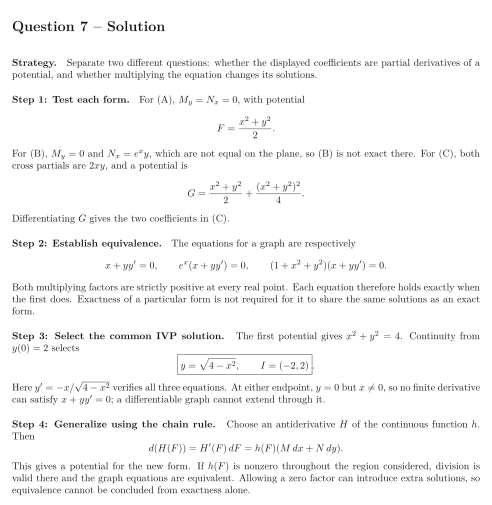
Compare the following forms on :
Tasks
Determine which forms are exact and give a potential for each exact form.
Prove that all three nevertheless have the same differentiable solution graphs.
Find their common solution graph with and its maximal open interval containing .
Let . Explain why multiplication by a continuous function produces another exact form, and state an additional condition that guarantees equivalence of the graph equations.
Show solutionHide solution
Question 7 – Solution
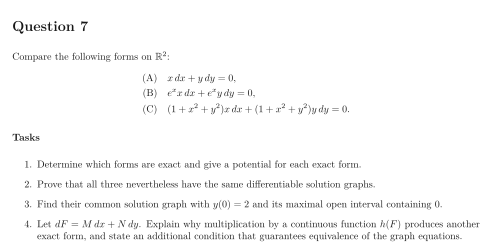
Strategy. Separate two different questions: whether the displayed coefficients are partial derivatives of a potential, and whether multiplying the equation changes its solutions.
Step 1: Test each form. For (A), , with potential For (B), and , which are not equal on the plane, so (B) is not exact there. For (C), both cross partials are , and a potential is Differentiating gives the two coefficients in (C).
Step 2: Establish equivalence. The equations for a graph are respectively Both multiplying factors are strictly positive at every real point. Each equation therefore holds exactly when the first does. Exactness of a particular form is not required for it to share the same solutions as an exact form.
Step 3: Select the common IVP solution. The first potential gives . Continuity from selects Here verifies all three equations. At either endpoint, but , so no finite derivative can satisfy ; a differentiable graph cannot extend through it.
Step 4: Generalize using the chain rule. Choose an antiderivative of the continuous function . Then This gives a potential for the new form. If is nonzero throughout the region considered, division is valid there and the graph equations are equivalent. Allowing a zero factor can introduce extra solutions, so equivalence cannot be concluded from exactness alone.