Question 8
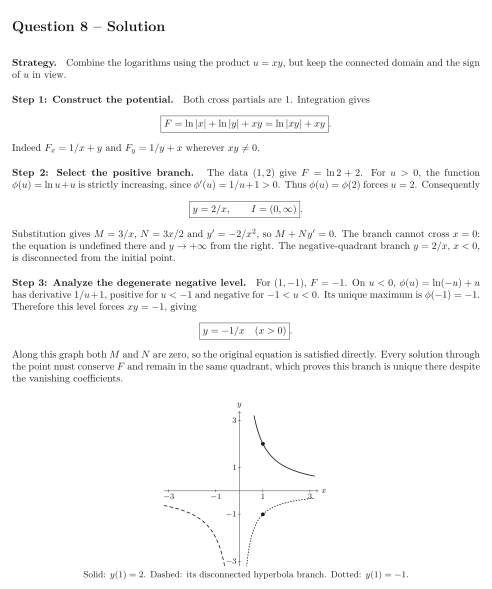
On the domain , consider
Tasks
Find a potential valid on this domain, using absolute values wherever required by logarithmic integration.
Use the initial condition to identify the correct level. On the positive quadrant, prove that the implicit relation reduces to an explicit solution.
Find its maximal interval containing . Explain why the branch of the same algebraic hyperbola in the negative quadrant is not an extension of this IVP.
Analyze the different initial condition . Determine its selected level and solution on , even though both coefficients vanish along that solution.
Show solutionHide solution
Question 8 – Solution
Strategy. Combine the logarithms using the product , but keep the connected domain and the sign of in view.
Step 1: Construct the potential. Both cross partials are . Integration gives Indeed and wherever .
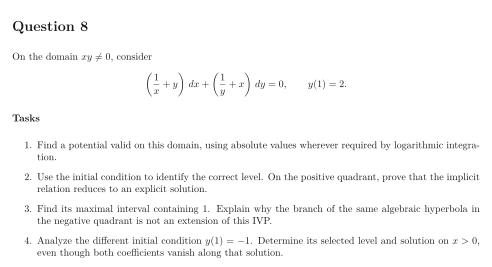
Step 2: Select the positive branch. The data give . For , the function is strictly increasing, since . Thus forces . Consequently Substitution gives , and , so . The branch cannot cross : the equation is undefined there and from the right. The negative-quadrant branch , , is disconnected from the initial point.
Step 3: Analyze the degenerate negative level. For , . On , has derivative , positive for and negative for . Its unique maximum is . Therefore this level forces , giving Along this graph both and are zero, so the original equation is satisfied directly. Every solution through the point must conserve and remain in the same quadrant, which proves this branch is unique there despite the vanishing coefficients.
See the diagram in the original worksheet below.