Question 9
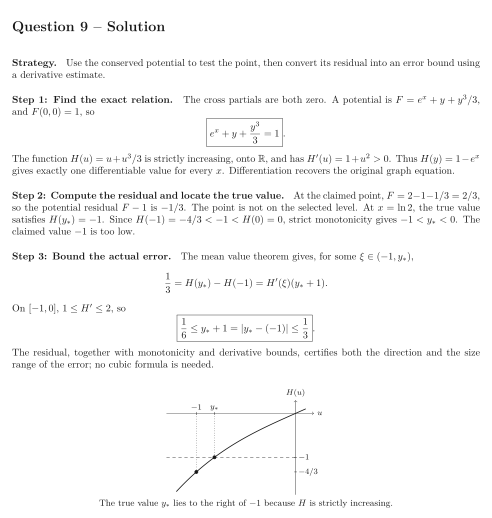
Consider An approximate calculation claims that the selected solution passes through .
Tasks
Find the exact implicit solution and prove that it defines a unique differentiable graph for all real .
Test the claimed point using the potential, without explicitly solving a cubic.
Let be the true value at . Prove and decide whether the claimed value is too high or too low.
Use the mean value theorem to prove the quantitative error bound Explain why a potential residual can provide more information than simply declaring an approximate point incorrect.
Show solutionHide solution
Question 9 – Solution
Strategy. Use the conserved potential to test the point, then convert its residual into an error bound using a derivative estimate.
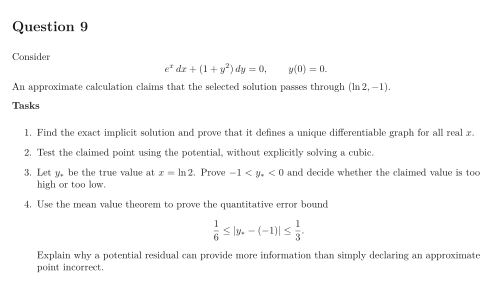
Step 1: Find the exact relation. The cross partials are both zero. A potential is , and , so The function is strictly increasing, onto , and has . Thus gives exactly one differentiable value for every . Differentiation recovers the original graph equation.
Step 2: Compute the residual and locate the true value. At the claimed point, , so the potential residual is . The point is not on the selected level. At , the true value satisfies . Since , strict monotonicity gives . The claimed value is too low.
Step 3: Bound the actual error. The mean value theorem gives, for some , On , , so The residual, together with monotonicity and derivative bounds, certifies both the direction and the size range of the error; no cubic formula is needed.
See the diagram in the original worksheet below.