Question 10
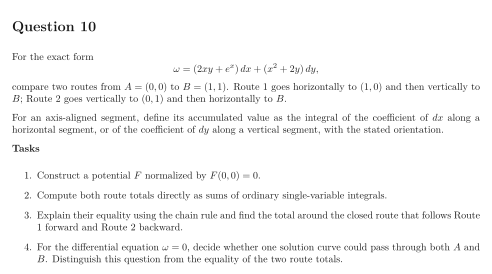
For the exact form compare two routes from to . Route 1 goes horizontally to and then vertically to ; Route 2 goes vertically to and then horizontally to .
For an axis-aligned segment, define its accumulated value as the integral of the coefficient of along a horizontal segment, or of the coefficient of along a vertical segment, with the stated orientation.
Tasks
Construct a potential normalized by .
Compute both route totals directly as sums of ordinary single-variable integrals.
Explain their equality using the chain rule and find the total around the closed route that follows Route 1 forward and Route 2 backward.
For the differential equation , decide whether one solution curve could pass through both and . Distinguish this question from the equality of the two route totals.
Show solutionHide solution
Question 10 – Solution
Strategy. A potential measures accumulated change along a route; a solution of the equation must instead keep that potential constant.
Step 1: Construct a normalized potential. The cross partials are . Integrating gives ; matching requires . Normalization yields
Step 2: Compute the routes directly. On Route 1, the horizontal and vertical contributions are so its total is . On Route 2 they are again totaling .
Step 3: Explain equality and the closed route. Along a differentiable parametrized segment, . Integration gives the endpoint difference of ; these differences telescope across joined segments. Both routes therefore give . Reversing a route negates its integrals, so the closed-route total is .
Step 4: Distinguish routes from solutions. A solution curve of has and stays on one level. Since and , no such curve can pass through both points. Equal route totals express endpoint dependence; they do not make either route a solution of the differential equation.
See the diagram in the original worksheet below.
