Question 3
Seek nonnegative, continuously differentiable solutions for of where the prime denotes and is the nonnegative square root.
Tasks
On an interval where , derive and solve the equation for .
Find every solution that waits at zero until a time and then becomes positive. Include the possibility of staying zero forever.
Check differentiability and the original equation at the joining time, and justify that your list is exhaustive for .
Explain why squaring a linear formula with does not give a valid solution of the original equation on that interval.
Show solutionHide solution
Question 3 – Solution
Strategy. The linearized equation applies only on positive pieces; restore zero intervals and enforce the sign of the square root.
Step 1: Solve a positive piece. Writing with gives , hence . Thus . If positivity starts at with , then , positive precisely for .
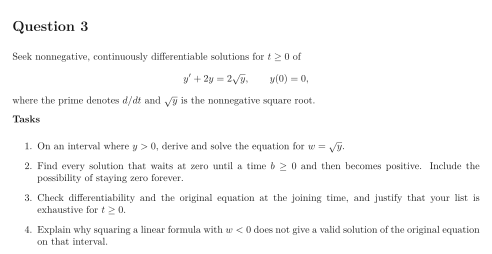
Step 2: Restore the zero intervals. For each finite , define Also include , denoted by . On the positive piece let ; then and . At a positive joining time, both one-sided derivatives are ; if , the right derivative is . Thus the solution is on its stated domain and satisfies the equation at the join.
Step 3: Prove completeness and reject a false extension. Any positive component must start from zero at its finite left endpoint, including , and the linear formula above fixes that component uniquely. It stays positive forever after , so it cannot end at another zero. Hence there is at most one positive component and the list is exhaustive.
For , the same linear expression has . If it is squared, , while the computed left side is . Thus it fails the original equation there. Squaring cannot remove this sign restriction.
See the diagram in the original worksheet below.