Question 5
For each real initial value , consider forward solutions of where the prime denotes .
Tasks
Solve using when , retaining the sign of . Treat separately.
Classify all according to whether the forward solution tends to zero, is constant, or blows up in finite time.
In the blow-up cases, find the exact lifetime and the sign of the divergence.
Verify the solution and explain why the threshold initial values are not included in either neighboring regime.
Show solutionHide solution
Question 5 – Solution
Strategy. A linear denominator exposes the threshold, while the sign of the original solution must be carried separately.
Step 1: Solve the transformed IVP. For , gives , so The denominator is the positive square root on the interval through . For , the unique solution is ; the smooth right-hand side ensures local uniqueness.
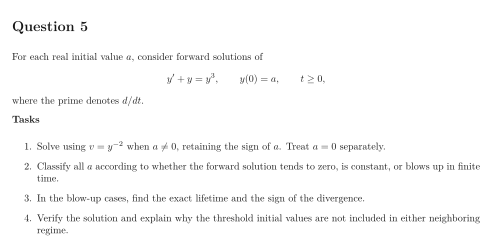
Step 2: Classify the thresholds. If , the denominator is positive for every and . This includes . If , the formula is constant: . If , the denominator first vanishes at The maximal forward lifetime is . As , for and for .
Step 3: Verify and interpret. For nonzero branches, implies , and the formula gives . The three constants also check directly. At the exponential term in is exactly zero; these solutions neither decay nor blow up. A threshold case must be substituted into the equation, not inferred from neighboring values.
See the diagram in the original worksheet below.