Question 6
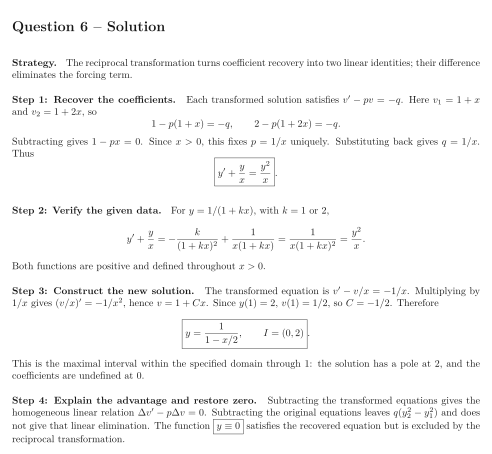
On , two positive solutions of one unknown Bernoulli equation are known exactly: Assume and are continuous there.
Tasks
Transform both solutions using and recover and uniquely.
Verify both supplied solutions directly in the recovered nonlinear equation.
Solve that equation with the different condition , and find its maximal interval within .
Explain why subtracting the original nonlinear solutions is less useful here than subtracting their transformed equations, and identify the solution lost by taking reciprocals.
Show solutionHide solution
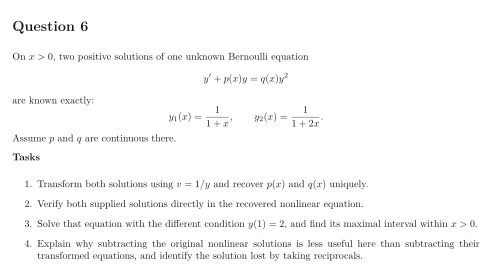
Question 6 – Solution
Strategy. The reciprocal transformation turns coefficient recovery into two linear identities; their difference eliminates the forcing term.
Step 1: Recover the coefficients. Each transformed solution satisfies . Here and , so Subtracting gives . Since , this fixes uniquely. Substituting back gives . Thus
Step 2: Verify the given data. For , with or , Both functions are positive and defined throughout .
Step 3: Construct the new solution. The transformed equation is . Multiplying by gives , hence . Since , , so . Therefore This is the maximal interval within the specified domain through : the solution has a pole at , and the coefficients are undefined at .
Step 4: Explain the advantage and restore zero. Subtracting the transformed equations gives the homogeneous linear relation . Subtracting the original equations leaves and does not give that linear elimination. The function satisfies the recovered equation but is excluded by the reciprocal transformation.